Fired Workers for AI, Now Hiring Them Back: A Smarter Staffing Plan for Service Firms
Companies rehiring after AI layoffs is the 2026 story. Here is an operator framework to right-size without the boom-bust whiplash, the costly over-fire.
In May 2026, Forbes ran a headline that captured the whole moment: "Companies Fired Workers For AI. Now They Want Them Back." The pattern it described is now so common it has a name — the AI boomerang. A company announces AI will do a job, downsizes the team, and six to twelve months later quietly reposts the roles it cut because the AI managed about 60% of the work and choked on the other 40% (Forbes, May 2026).
This is hot right now for a reason. AI became the single most-cited cause of US layoffs in March and April 2026, ahead of every other reason (Founder Reports AI Layoffs Tracker, citing Challenger, Gray & Christmas). And the rehiring wave is already underway. If you run a service business, an agency, or any small team, the useful question is not "should I use AI" — obviously yes — but how do I add AI without firing the people I'll be begging to come back next quarter? That is what this article gives you: an operator's framework for right-sizing without the boom-bust whiplash.
The 2026 fire-then-rehire cycle, by the numbers
The trend is real and measurable, not vibes. Here is what the data actually says:
- AI was cited as the reason for 21,490 US job cuts in April 2026 alone — about 26% of all layoffs that month, up from roughly 5% a year earlier (Founder Reports, citing Challenger, Gray & Christmas).
- 51% of business leaders said their company will lay off existing workers in 2026 specifically because AI is consolidating or eliminating roles (Resume.org survey of ~1,000 US leaders, via Founder Reports).
- And then the reversal: 29% of organizations that cut staff for AI had already rehired into the positions they cut, according to Robert Half data cited by Forbes (Forbes, May 2026).
A separate study sharpens the picture. Careerminds polled 600 HR professionals who made layoffs in the prior 12 months and found that roughly two in three employers that cut staff for AI were already rehiring — 32.7% had rehired between a quarter and half of the roles they let go, and another 35.6% had rehired more than half (Careerminds study, via HRD America). More than half of those leaders (52.1%) rehired within just six months.
The forward-looking forecasts say this is only beginning. Forrester predicts 55% of executives who replaced employees with AI will regret it within 18 months, and Gartner expects that by 2027, half of companies that cut customer-service jobs for AI will rehire for similar functions under new titles (both cited by Forbes).
The takeaway: the layoff is loud and the rehire is quiet, but the rehire is happening at scale. Planning around it now is cheaper than discovering it the hard way.
Why over-firing for AI backfires (and what it really costs)
The core mistake is deceptively simple. As Forbes puts it, companies assumed AI would replace people, when in reality AI replaces tasks. A customer-service rep does not just answer questions — they sense when a customer is genuinely in trouble, decide whether a refund is warranted, remember that a high-value client has been escalated twice this month, and judge when to pull in a supervisor. AI is good at the answering part. It cannot hold the judgment, the memory, or the relationship (Forbes, May 2026).
The Careerminds data confirms this is the rule, not the exception. Only 21.4% of leaders said AI fully replaced roles with no operational issues; 66.1% said only some roles were replaced successfully, and more than half said AI required more human insight than they expected (Careerminds, via HRD America). Harvard economist David Deming's research points the same direction: AI does not replace social skills and judgment — it raises their value (cited by Forbes).
Now the cost. Rehiring is not a clean reversal — it is more expensive than the original headcount:
| Cost of the over-fire | What actually happens |
|---|---|
| Higher salary | The rehire must now manage the AI too, so a $55,000 role can come back at roughly $75,000 (Forbes) |
| Recruiting again | You pay to source, interview, and onboard a second time |
| Lost institutional knowledge | The eight-year veteran who knew which client disputes every charge is gone — and that does not come back in a week |
| Morale and trust | Remaining staff watched the company replace a colleague with software, then repost the job — and start quietly looking elsewhere |
| Service-quality dip | Klarna publicly claimed its AI did the work of 700 agents, then reversed course and rehired after satisfaction dropped (Founder Reports) |
There is also a strategic catch worth naming: a Gartner study of 350 executives at billion-dollar firms found no correlation between AI-driven workforce cuts and improved ROI (Founder Reports, citing Gartner). Cutting heads created budget room, not returns. For a small firm, that gap shows up fast — lose 5% of a 15-person team's clients and you may have lost your most profitable, most human-intensive accounts, because those are exactly the ones automation can't hold.
How to decide what AI can replace vs what needs people
The decision is not "AI or person." It is which tasks go to AI and which stay human. Borrowing and tightening the approach Forbes recommends, run this audit before you touch headcount:
- Audit tasks, not titles. Most people do 15–20 distinct tasks a week. Have each team member keep an activity log for two weeks. You are mapping work, not judging roles.
- Sort every task into two buckets. Routine and repeatable (data entry, first-pass drafting, ticket triage, scheduling, standard quotes) vs context-dependent and judgment-based (escalations, anomaly detection, relationship calls, edge-case decisions).
- Assign routine work to AI, keep judgment with people. Nobody loses a job; everyone gains capacity. This is the move that adds AI without triggering the boomerang.
Use this rule of thumb when you're unsure which bucket a task belongs in:
| Likely safe to automate | Keep human |
|---|---|
| High volume, low variation | Low volume, high stakes |
| One correct answer | Many plausible answers, one right one |
| No memory of past context needed | Depends on history with the client |
| No accountability for the outcome | Someone must own the result |
| AI produces the answer | A human decides if the answer is right |
The deeper point: the hardest people to replace are those who hold institutional knowledge — who know which vendor invoices late, which client disputes every charge, what to watch in Q4. No AI reproduces eight years of pattern recognition (Forbes, May 2026). Automate around those people, not through them.
Right-sizing a team without the boom-bust whiplash
Right-sizing means matching capacity to real, durable demand — not to a forecast of what AI might do next year. The whiplash comes from treating an uncertain bet as a permanent decision: fire on the optimistic case, rehire on the realistic one, and eat the cost of both swings.
A few principles keep you out of the cycle:
- Move in small, reversible steps. Pilot AI on a task, measure the time saved and the quality delta over a quarter, then decide on capacity. The Gartner analysts described many of these layoffs as "a one-time exercise" rather than structural transformation — don't make a structural cut off a non-structural gain (Founder Reports, citing Gartner).
- Be honest about your own AI-washing. Nearly 6 in 10 companies admit they frame cuts as AI-driven when the real reason is financial (Founder Reports, citing Resume.org). If the real driver is budget, name it — and solve the budget problem directly instead of dressing it up as automation and over-cutting.
- Separate permanent core from variable load. Keep a lean permanent team for the work that compounds (institutional knowledge, client ownership, core IP) and meet the variable, spiky, or uncertain load with flexible capacity rather than permanent hires you may have to unwind.
That last principle is where most of the leverage lives — and it's exactly the gap staff augmentation fills.
Staff augmentation as a low-risk middle path
Staff augmentation means adding skilled, vetted people to your team on a flexible basis — they work as part of your team, under your direction, without becoming permanent employees on your books. In a year where the cost of guessing wrong is a hire-fire-rehire cycle, that flexibility is the entire point.
Here is how the three common responses to AI uncertainty compare:
| Approach | Speed to flex up | Speed to flex down | Rehire / boomerang risk | Keeps institutional knowledge |
|---|---|---|---|---|
| Permanent hire-then-fire | Slow (weeks to months) | Slow + costly (severance, morale) | High | No — it walks out the door |
| All-in on AI, cut humans | Instant on paper | N/A | Very high (Forrester: 55% regret) | No |
| Staff augmentation | Fast (often weeks) | Fast, low-friction | Low | Yes — same people can scale back up |
The mechanics matter. When you over-fire and rehire, you reset the recruiting clock, pay a higher salary, and lose months of context every cycle. With augmentation, you scale a team up when demand is genuinely there and scale it back when AI actually absorbs work — without severance, without the morale hit of public layoffs, and often with the same people available when you need them again. It is the operational opposite of the boomerang.
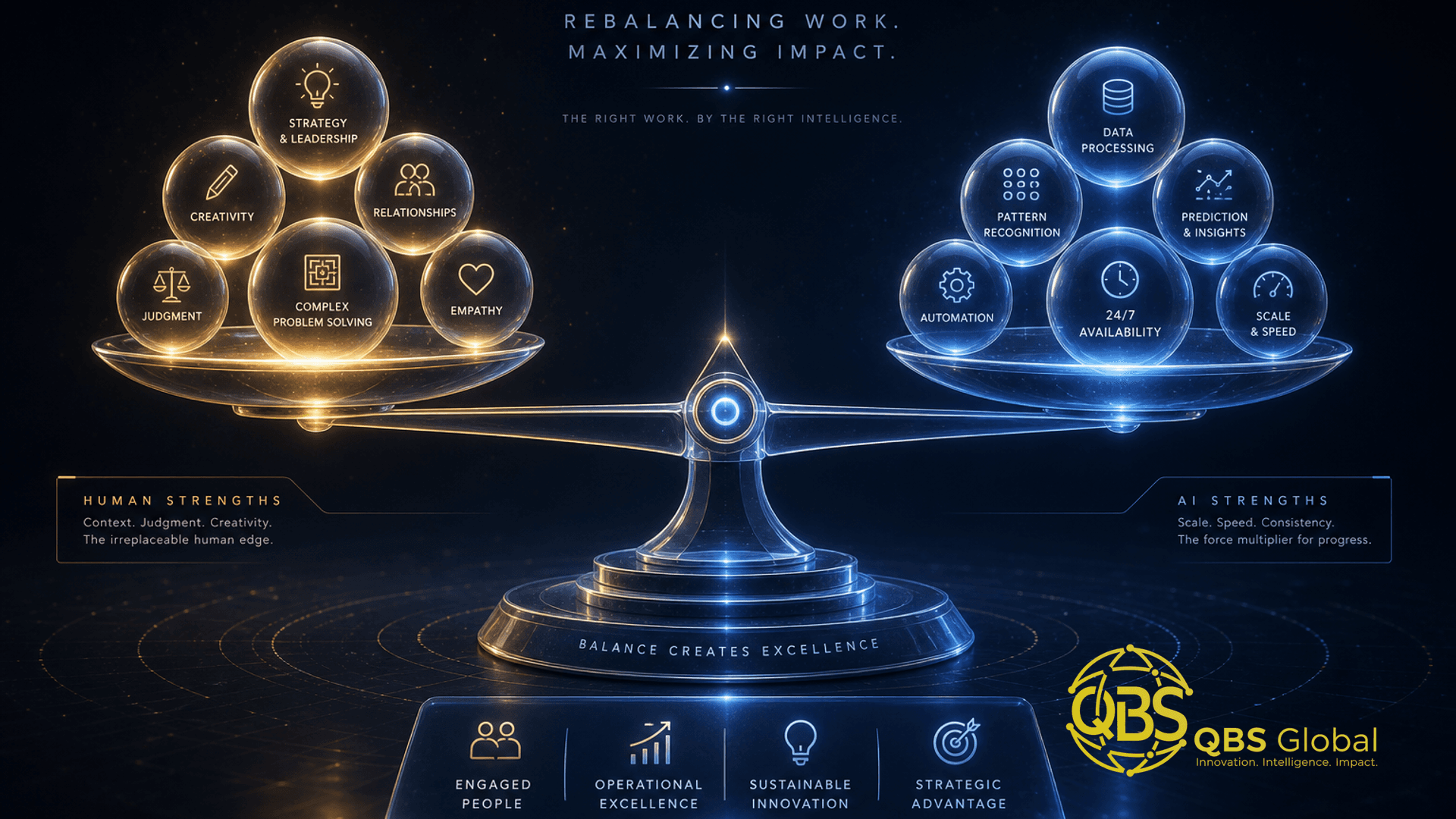
It also pairs naturally with AI rather than competing with it. The smartest move for most service firms in 2026 is AI for the busywork, flexible human capacity for the judgment — automate the repetitive 60% and staff the judgment-heavy 40% with people you can dial up or down. If you're weighing the raw economics of flexible vs permanent headcount, we broke down the line items in our in-house vs staff augmentation cost comparison, and if you're deciding which engagement model fits your situation, our guide to EOR vs staff augmentation vs PEO walks through the trade-offs.
A staffing plan that flexes as AI matures
Here is a concrete, sequenced plan you can run this quarter. It assumes AI keeps improving — and stays flexible enough that you're never the company quietly reposting the jobs it just cut.
1. Map the work (Weeks 1–2). Run the task audit above. You now have two lists: routine-automatable and judgment-human.
2. Automate the busywork, not the people (Weeks 2–6). Deploy AI on the routine list — drafting, triage, scheduling, first-pass quotes — using off-the-shelf tools (ChatGPT, n8n, Zapier, or a custom workflow). Measure time saved per task. Keep your people on judgment work; reinvest their freed-up hours into higher-value output, not a pink slip.
3. Meet new or spiky demand with flexible capacity, not permanent hires (ongoing). When the freed-up capacity reveals real growth, add augmented specialists for the surge instead of committing to permanent headcount you might unwind. This is also how you build a distributed delivery bench — our guide on how to build an offshore development team in 2026 covers the operating model.
4. Keep a thin layer of senior judgment in-house or fractional (ongoing). Some decisions need an owner, not a contractor and not a model. For the strategic and oversight layer, a part-time senior leader is often the right call — see when to hire a fractional executive for the timing.
5. Re-audit every quarter (ongoing). AI capability moves fast. A task that needed a human in Q1 may be automatable by Q3 — and vice versa. Because your variable capacity is flexible, you adjust without firing anyone or triggering a rehire.
The thread running through all five steps: make the reversible decisions with AI and flexible staffing, and reserve permanent commitments for work that is genuinely permanent. That is how you compound capability instead of swinging between over-firing and panic-rehiring.
Questions to ask before you cut a role for AI
Before you eliminate any position because "AI can do it," run it through these seven questions. If you answer "no" or "I'm not sure" to several, you are a strong candidate for the boomerang — pause and right-size instead.
- Have I audited the actual tasks, or just the job title? Roles bundle routine and judgment work. Cutting the role cuts both.
- What share of this role is genuine judgment, relationship, or anomaly-detection work? That share does not survive automation.
- Will the rehired version cost more than I'm saving? A returning role often comes back higher because it now manages AI (Forbes).
- What institutional knowledge walks out the door, and can I afford to lose it? Years of context don't reload in a week.
- Is AI actually the reason — or is this a budget cut I'm labeling as AI? Be honest; 6 in 10 firms aren't (Founder Reports, citing Resume.org).
- Have I piloted and measured, or am I cutting on a projection? Cut on proven results, not a demo.
- Could I get the same flexibility by flexing capacity instead of firing? Augmentation lets you adjust without the one-way door.
Bottom line: the firms that win in 2026 are not the ones that cut hardest or the ones that ignore AI. They're the ones that automate the busywork, keep the judgment human, and use flexible staffing to adjust as the technology matures — never getting stuck on the wrong side of a permanent decision.
If you're trying to figure out where AI genuinely fits, what to keep human, and how to add flexible capacity without the hire-fire-rehire whiplash, that's exactly the kind of plan we help service firms build. Book a free 30-minute call with QBS Global and we'll map a right-sized roadmap — automation plus flexible staffing — tailored to your team within 48 hours.
Frequently asked questions
Why are so many companies rehiring after AI layoffs in 2026?+
Because AI handled the routine portion of jobs well but failed at the judgment, context, and relationship work that the same roles also carried. Once service quality dropped, firms had to rehire. A Careerminds study found roughly two in three employers that cut staff for AI were already rehiring by early 2026, and Robert Half data cited by Forbes put already-rehired at 29%.
How much does it cost to rehire a role you cut for AI?+
More than you saved. You pay recruiting and onboarding again, usually a higher salary because the new hire must also manage AI tools, and you absorb months of lost institutional knowledge. Forbes illustrates a $55,000 role coming back at around $75,000, which can erase the original automation saving entirely.
Should I lay off staff and replace them with AI in 2026?+
Rarely all at once. Audit tasks, not roles: assign routine, repeatable tasks to AI and keep people on judgment, escalation, and relationship work. Over-firing is the expensive mistake because small firms feel a service-quality drop within weeks, not quarters, and the most profitable clients are usually the most human-intensive.
How is staff augmentation a hedge against AI uncertainty?+
It lets you add or remove skilled capacity in weeks instead of running a hire-fire-rehire cycle that resets recruiting cost and destroys institutional memory each time. You flex an augmented team up when demand is real and down when AI genuinely absorbs work, without the severance, morale, and boomerang costs of permanent layoffs.
What roles should stay human even as AI matures?+
Anything that depends on judgment, accountability, client relationships, anomaly detection, or hard-won institutional knowledge. AI is strong at producing answers but weak at deciding which answer is right, remembering past context, and owning an outcome. Harvard research found AI tends to raise the value of social and judgment skills rather than replace them.
Is AI actually the reason for most 2026 layoffs?+
Partly. AI was the single most-cited reason for US job cuts in March and April 2026, but surveys also show nearly 6 in 10 companies admit they label financially-driven cuts as AI-driven because it sounds strategic. Treat any blanket AI-replacement claim, including your own internal one, with healthy skepticism before you cut headcount.