Should Your Brand Have an AI Influencer? A Practical Guide for Small Service Businesses
An AI influencer for small business: realistic cost, effort, tools, and disclosure rules — plus a go/no-go checklist for service firms in 2026.
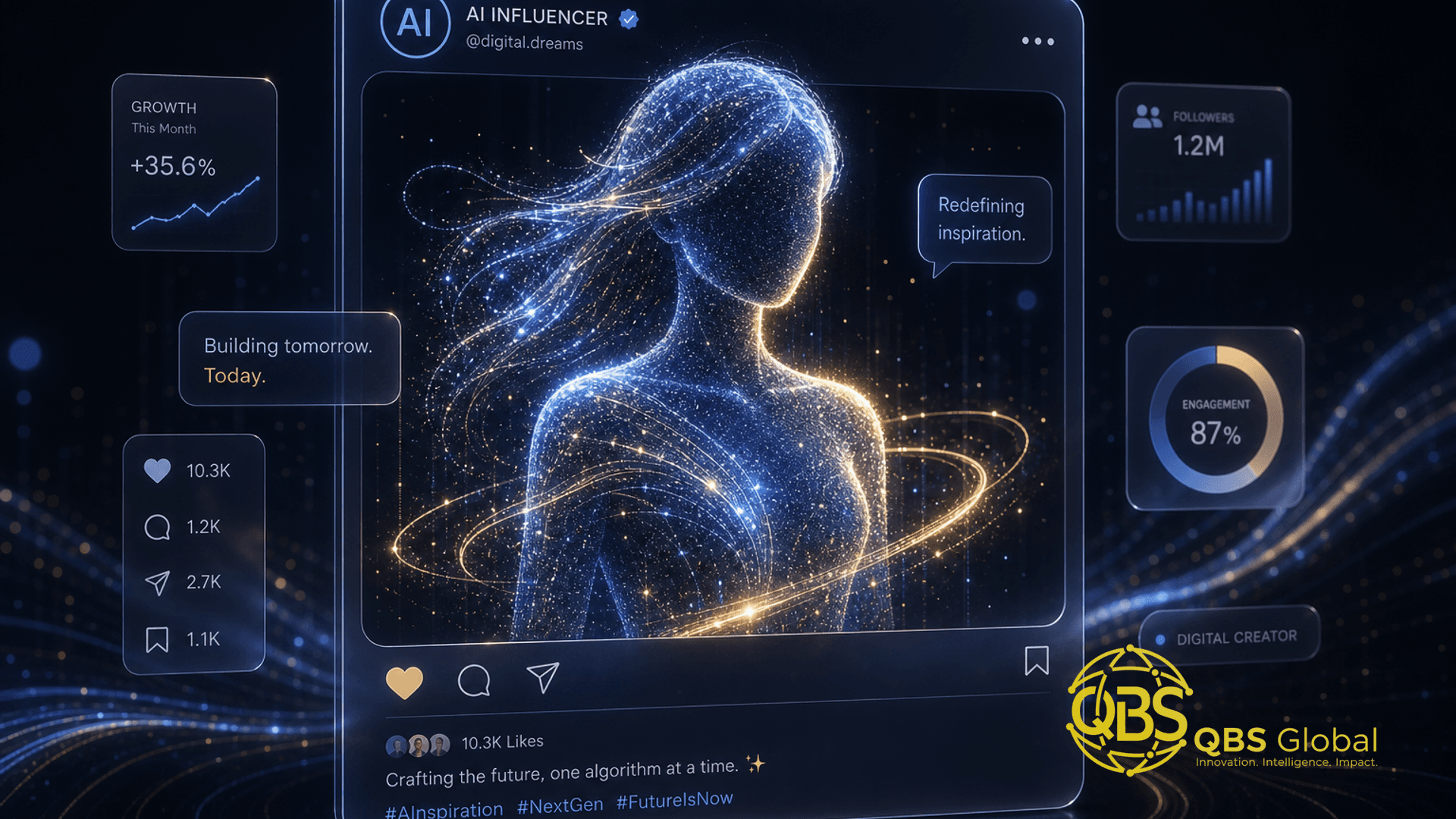
Search interest in "AI influencer" has climbed sharply into 2026, and the related queries people pair with it are blunt about what they actually want: "AI influencer generator" and "how to create an AI influencer." This is no longer a curiosity about distant celebrity avatars. Small business owners are typing these searches because they want to know whether a synthetic brand face is a real marketing option for them — and what it costs.
So let's answer the question the tool sites and trend reports skip. Not "the 12 best generators," but the decision underneath it: should a small service business build an AI influencer at all, what does it realistically cost and take to run, and when is it a smart move versus a gimmick? We build content and automation systems for service firms for a living, so this is the operator's view — vendor-neutral, with the traps left in.
What an AI influencer actually is
An AI influencer (or virtual brand ambassador) is a fully synthetic persona — a consistent face, name, and voice generated by AI — that creates and posts content the way a human creator would. It is not a chatbot and not a filter on your own face. It is a digital character that can appear in photos and videos, talk to camera, and carry a recognizable identity across your social channels.
The category is bigger than it feels. The global virtual influencer market was estimated at roughly $6.06 billion in 2024 and is projected to reach about $45.88 billion by 2030, a compound annual growth rate near 41% (Grand View Research). And the audience is already there: in a March 2022 US survey, 58% of consumers said they followed at least one virtual influencer (Statista) — a number that has only risen since. People are not repelled by synthetic creators the way you might expect.
For a small service business, the useful framing is narrower than the celebrity-persona hype. Think of an AI influencer less as a star and more as a tireless on-brand presenter: a face that explains what you do, answers the same five questions every prospect asks, and gives your feed visual consistency — without you ever standing in front of a camera.
The case for (and against) building one
The honest version of this has two columns. Let's run both.
The case for. The strongest argument is leverage. A solo founder or a two-person service team has no time and no on-camera budget, and yet short-form video is where attention lives. An AI persona lets you produce a steady stream of talking-head content — tips, explainers, before-and-afters — at a flat monthly cost, in a fraction of the time. It never has an off day, never needs a reshoot for a typo, and builds recognition through a consistent visual style. For a business posting nothing because filming feels impossible, "something consistent" beats "perfect but absent."
The case against. A synthetic face does not generate trust on its own — and trust is the entire product a service business sells. If your audience senses they are being sold by a character that does not exist, in a category where they are hiring a human, the persona can read as evasive. There is also a sameness risk: the same tools produce the same uncanny aesthetic, and a generic AI avatar can make you look like every other low-effort account. And it solves a distribution problem, not a positioning one. If your offer is unclear, a fake spokesperson just delivers an unclear offer more often.
Here is the filter we use:
| Build an AI influencer if... | Skip it (for now) if... |
|---|---|
| You are not posting video at all and the blocker is being on camera | You already have a founder comfortable on camera |
| Your service is high-volume, consumer-facing, repeatable | Every sale hinges on personal trust and bespoke work |
| You can commit to a weekly content cadence for 3+ months | You want a one-off campaign and then silence |
| You have a clear offer the persona can simply repeat | Your positioning is still vague |
If you are doing this because filming yourself is the real bottleneck, you may not even need a fully synthetic persona — AI-generated talking-head and product content can do most of the job. We unpack that lighter path in AI UGC video ads for a service business.
Realistic cost and effort to launch and run one
This is where the trend coverage is most misleading. The tool marketing implies a persona is a one-click asset. The reality is that the software is cheap and the human time is the cost.
Software. Consumer AI influencer and video tools in 2026 are inexpensive. Entry plans commonly start around $19 to $29 per month, and a full working stack — image generation, character consistency, and AI video — typically lands in the $50 to $150 per month range (EComposer tool review). You can prototype a persona's look on free tiers before you pay anything. Enterprise "managed virtual human" services exist at $2,000+ per month with dedicated creative teams, but a small business has no reason to start there.
The real cost: human time. A persona that posts twice a week needs someone to script the content, generate the visuals, fix the inevitable AI weirdness (hands, lip-sync, brand colors), caption it, and publish on schedule. Realistically that is 4 to 8 hours a week once you have a system, and more while you are learning the tools. That labor — yours or someone you pay — is the line item that decides whether this is worth it.
A rough first-year picture for a solo operator:
| Item | Realistic range |
|---|---|
| Tool stack | $20 – $150 / month |
| Setup time (persona design, voice, templates) | 10 – 20 hours, one-time |
| Ongoing production | 4 – 8 hours / week |
| Optional: outsourced production | varies; pay for the hours, not the tools |
The takeaway: the subscription is a rounding error; the weekly grind is the budget. Plan for the grind, or plan to outsource it, before you start.
Tools and workflow to produce on-brand video at flat cost
You do not need to name a winner — the category churns monthly. You need a repeatable pipeline. Here is the shape of one that produces consistent, on-brand video without a studio:
- Lock the persona. Generate a character with a fixed look using an image model, then save a reference so every future image matches. Consistency is the whole game — a face that drifts week to week reads as broken.
- Define the voice and brand frame. Pick one voice (synthetic or your own), one color palette, one caption style, and one intro format. Templating this is what makes the output look intentional rather than random.
- Script in batches. Write 8 to 12 short scripts at once from your real FAQs and service explanations. This is the highest-leverage step and the one to keep human — it is your actual expertise.
- Generate video. Feed scripts to an AI video tool to produce talking-head clips with your persona. Render several at a time.
- Edit and caption. Trim, add captions, fix artifacts, drop in your logo and call to action.
- Schedule and post. Queue a week or two ahead so the cadence survives a busy week.
The unlock is batching plus templates. Most small businesses fail here not because the tools are weak but because they treat each post as a from-scratch project. Build the system once, then each post is an hour, not an afternoon. If you would rather not own that pipeline, outsourcing the repetitive scripting-to-publish production is exactly the kind of busywork worth handing off so you can stay on billable work.
Trust and disclosure: keeping a synthetic persona honest
This is non-negotiable in 2026, and the rules got sharper this year. Skipping disclosure is the fastest way to turn a clever content play into a liability.
In the US, FTC guidance requires clear and conspicuous disclosure when AI materially affects how a consumer interprets content, with AI-generated testimonials and synthetic spokespeople squarely in scope (FTC guidance summary). In the EU, the AI Act's transparency obligations apply in full from August 2, 2026, requiring AI-generated content to be marked both visibly and in machine-readable form (European Commission). Major ad platforms now require a visible "AI-generated" label on paid content featuring synthetic people as well.
The practical rules are simple and cheap to follow:
- Label the persona as AI in the bio and, where the content could mislead, on the posts themselves. "AI-generated" or "Made with AI" is enough.
- Never fake proof. Do not have your synthetic persona deliver a fabricated testimonial, invent a client result, or claim an experience it did not have. That is where disclosure stops being a label and becomes fraud.
- Keep claims true. A synthetic face delivering an honest message is fine. A synthetic face delivering a false one is a problem no disclaimer fixes.
The deeper point: disclosure is not a tax on a good idea, it is what keeps the idea good. Audiences forgive "this is an AI character." They do not forgive being deceived. For the full breakdown of what the new regimes require, see our guide to labeling AI-generated content under the 2026 rules.
How it fits a B2B vs B2C service brand
The single biggest mistake is assuming an AI influencer works the same everywhere. It does not. The fit depends almost entirely on how trust is built in your category.
| B2C service brand | B2B service brand | |
|---|---|---|
| Buyer trust signal | Reach, familiarity, a friendly face | A credible real human and proof of expertise |
| AI persona as lead voice | Often works well | Usually backfires |
| Better AI use | Synthetic persona for volume and reach | AI tooling to scale a real founder's content |
| Disclosure sensitivity | Moderate | High — credibility is the product |
For B2C and consumer-facing services — a cleaning company, a fitness brand, a local food business — a synthetic persona can carry the front line. Reach and repetition matter more than knowing the person behind every post, and a consistent, friendly face is an asset.
For B2B services — software, consulting, recruiting, anything where a buyer commits real budget to a relationship — leading with a fake spokesperson tends to erode the exact thing you are selling. The smarter move is to point the same AI video tooling at a real person: turn one founder recording into a steady stream of polished, on-brand clips. You get the production leverage without trading away credibility.
Either way, the persona is a format, not a strategy. The brands that waste money here are usually the ones already making the basic social media mistakes small businesses make — no clear offer, no cadence, no idea who they are talking to. An AI influencer poured on top of that just produces more noise, faster.
A go/no-go decision checklist
Run your situation through this before you spend a dollar. If you cannot answer yes to the first three, do not build one yet.
- Do I have a clear, repeatable offer the persona can simply state? (If your pitch is vague, fix that first.)
- Is the real blocker that I am not on camera — not that I have nothing to say?
- Can I commit to a weekly cadence for at least 3 months? (A persona that posts twice and stops is wasted money.)
- Does my category tolerate a synthetic face? (Consumer-facing: usually yes. Trust-heavy B2B: lead with a real human instead.)
- Will I disclose it clearly in the bio and on synthetic posts, and never fake proof?
- Who owns the weekly production — me, a hire, or a partner? (Name the person, or it will not happen.)
- What is the call to action, and where does it send people? (Views without a path to a conversation are a hobby, not marketing.)
If you got mostly yes, start small: build one persona, post for a month, measure whether it drives saved posts, profile visits, and actual inquiries — not just views. If you got several no's, the honest answer is that your time is better spent on offer and distribution first, and an AI influencer later.
If you want a second pair of eyes on whether a synthetic persona fits your service brand — or you would rather skip the tooling rabbit hole and have the content engine built and run for you — we offer a free 30-minute call and will come back within 48 hours with a tailored roadmap for your situation, no obligation.
Frequently asked questions
What is an AI influencer for a small business?+
It is a fully synthetic brand persona — a face, a name, a voice — generated and animated by AI, that posts on your behalf the way a human creator would. For a small service business it is less a celebrity and more a consistent on-brand presenter: it explains what you do, answers common questions, and gives your social feed a recognizable face without you ever stepping in front of a camera. It is a content tool, not a magic audience.
How much does it cost to create and run an AI influencer?+
Far less than people assume. A workable stack of consumer AI tools runs roughly $20 to $150 per month in 2026, and you can prototype a persona on free tiers first. The real cost is not the software — it is the 4 to 8 hours a week of human time to script, generate, edit, and post consistently. Budget for the labor, not just the subscription, and the math stays honest.
Do I have to disclose that my influencer is AI-generated?+
Yes, in most markets, and the rules tightened in 2026. US FTC guidance requires clear disclosure when AI materially changes how consumers interpret content, and the EU AI Act mandates visible and machine-readable labeling of AI-generated content from August 2026. Practically: label the persona as AI in the bio and on synthetic posts. It is cheap to do and expensive to skip.
Is an AI influencer better for B2B or B2C service brands?+
It maps more naturally to B2C and high-volume consumer-facing services, where reach, repetition, and a friendly face drive results. In B2B services, buyers want a real human and real credibility, so a fully synthetic persona can backfire as the lead voice. B2B firms get more value using the same AI video tooling to scale a real founder's content rather than inventing a fake spokesperson.
Will an AI influencer actually get me customers, or just views?+
On its own, neither — a persona is a distribution format, not a strategy. It earns customers only when it is attached to a real offer, a clear call to action, and a consistent posting cadence over months. Treat it like any other content channel: it amplifies a message that already works. If your offer and targeting are weak, a synthetic face will not fix them.
Can I build an AI influencer myself or do I need an agency?+
A solo operator can absolutely build and run one with off-the-shelf tools — that is the whole point of the 2026 tooling. You need an agency or a partner only when you want it done consistently without owning the weekly production grind, or when you want it wired into a broader content and lead system. Start DIY to learn what works, then outsource the repetitive production once the format proves itself.