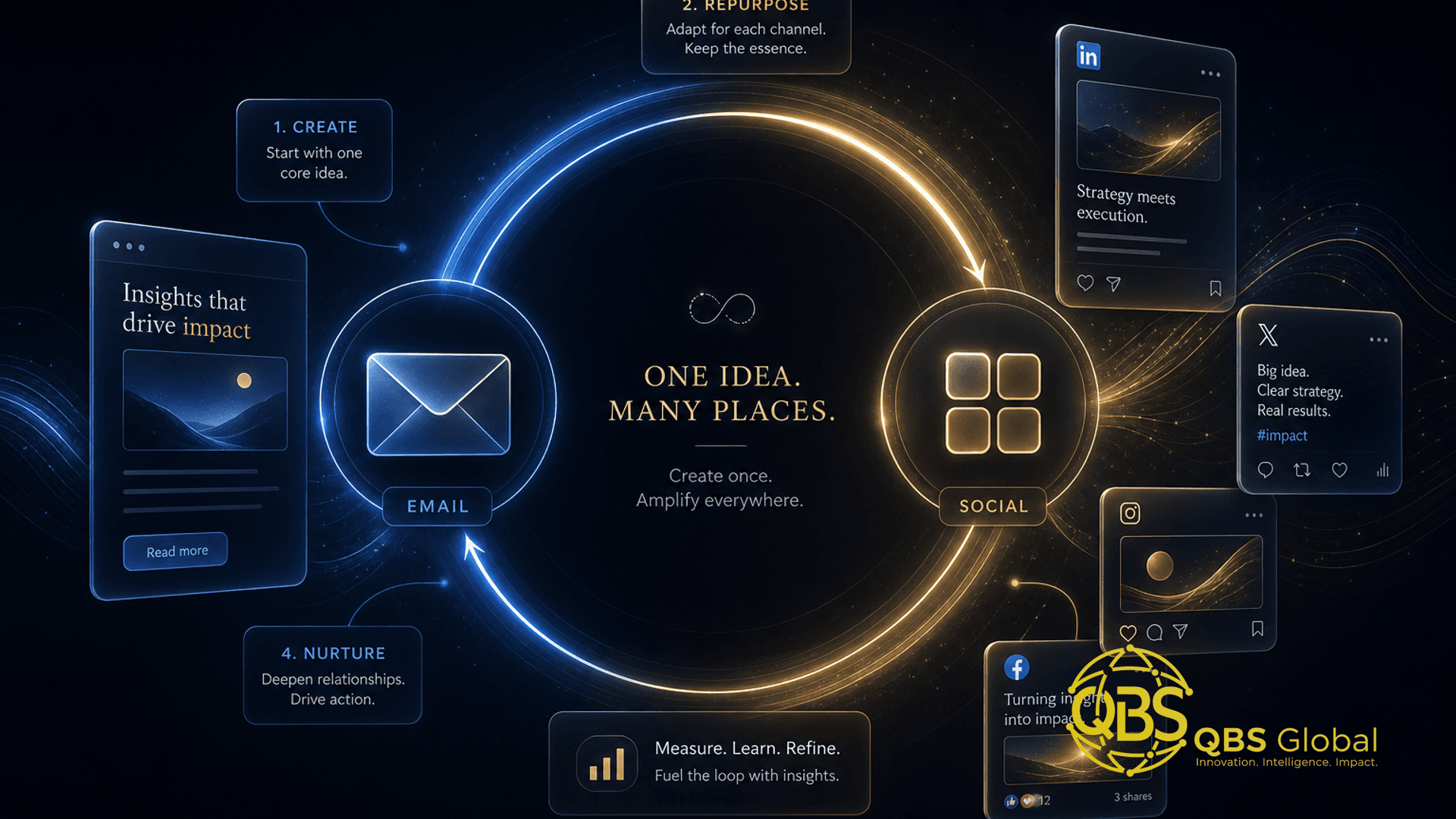
The Content Repurposing System: Turn One Blog Post Into 2 Weeks of Social Posts
A repeatable content repurposing system that turns one blog post into two weeks of social posts — the workflow, the splits, and where to automate it.
Most service businesses do not have a content problem. They have a distribution problem. You write something genuinely useful, publish it once, watch it collect a handful of views, and move on — burying your best thinking under a single timestamp. Then next week you start from a blank page again, as if the last idea never happened.
This article lays out the fix: a concrete, repeatable system that turns one anchor piece into roughly 15 social posts — close to two weeks of a normal calendar — with the exact platform splits and a weekly workflow you can hand to anyone. It is not a list of AI tools. It is the system the tools are supposed to serve.
Why one-and-done content wastes your best ideas
Publishing something once and never touching it again is the most common, most expensive mistake in service-business marketing. You spent real hours on that post. Then you let a single day's algorithm decide its entire lifetime.
The math is unkind. Most small businesses already spend 3 to 10 hours a week on social media, and content creation alone eats 40 to 50 percent of that time. So you are paying — in your own hours or someone's salary — to produce material, and then throwing away most of its reach by showing it to one audience, in one format, one time.
One-and-done quietly doubles your cost per idea. You do the expensive part (thinking, researching, writing) and skip the cheap part (reshaping and redistributing). The cheap part is where almost all the leverage lives.
There is also a consistency tax. When every post starts from zero, you post in bursts and then go quiet — which is exactly the rhythm social platforms punish hardest. A repurposing system breaks that cycle because you are never staring at a blank page. You are always mining something you already built.
The core idea: one anchor, many atoms
The whole system rests on two words: anchor and atom.
An anchor is one substantial piece that holds a complete argument. It is researched, it has a point of view, and it could stand on its own. A blog post is the classic anchor, but so is a recorded webinar, a conference talk, a long client email, or a 45-minute conversation you transcribe.
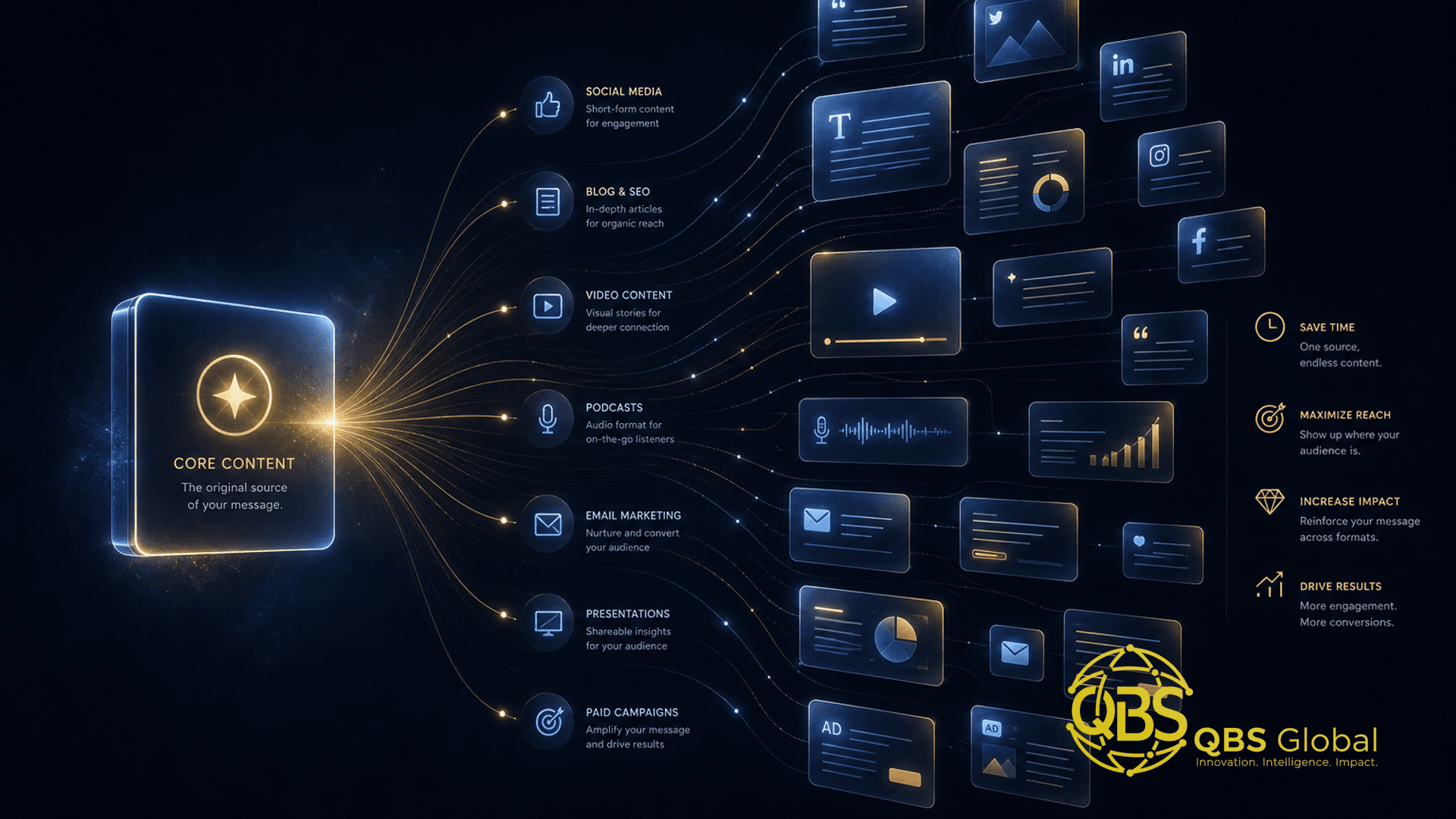
An atom is a single idea pulled out of the anchor and rewritten to live on its own. One statistic. One contrarian opinion. One three-step mini how-to. One myth you want to kill. One customer question and your answer. Each atom is small, self-contained, and built for a specific platform.
The shift in thinking is this: you are not creating 15 things a week. You are creating one thing a week and harvesting it 15 ways. A good anchor is dense — it usually contains six to ten distinct ideas you raced past on the first draft. Repurposing slows down and gives each of those ideas its own moment.
This is also why the "automate the busywork" promise matters here. The hard, human part is the anchor — the thinking. The atoms are mostly transformation work: reshaping, resizing, rewording. That is precisely the kind of repetitive task you systemize and offload.
The repurposing system (one post into ~15 pieces)
Here is the repeatable breakdown. Take one anchor — assume a 1,500 to 2,000 word blog post — and run it through this template. In our experience these counts hold up across most B2B topics, give or take a couple of pieces depending on how dense the anchor is.
| Atom type | What it is | How many | Best home |
|---|---|---|---|
| Key takeaway posts | One core point, expanded into a short narrative | 3 | |
| Contrarian / myth-buster | The "everyone believes X, but..." angle | 1 | LinkedIn / X |
| Stat or data point | One number with your interpretation | 2 | X |
| Mini how-to / list | A 3–5 step extract from a section | 2 | X / LinkedIn |
| Quote or one-liner | A sharp sentence from the post, reformatted | 2 | X / Instagram |
| Visual / carousel | The post's framework as a slide or graphic | 2 | |
| Question prompt | A question the post answers, posed to the audience | 1 | LinkedIn / X |
| The post's argument, written directly to subscribers | 1 | ||
| Repost / remix | Your best-performing atom, reworded two weeks later | 1 | Anywhere |
That is roughly 15 pieces from a single anchor. Posted at a sane cadence, 15 pieces covers close to two working weeks — which means a service business publishing two solid anchors a month is never short of material.
The discipline that makes this work: one atom equals one idea. Do not try to cram the whole post into each piece. The blog post is the place for the full argument. Each atom is allowed to make exactly one point and then stop. That restraint is what makes the posts feel native instead of like recycled blog snippets.
What makes an anchor "repurposable"
Not every piece atomizes well. The anchors that produce the most atoms share three traits: they take a clear position (positions generate contrarian and myth-buster atoms), they contain specific numbers (numbers become stat posts), and they include at least one framework or step-by-step (frameworks become carousels and how-tos). If you write your anchors knowing they will be mined, you naturally build in more handles to grab.
The platform splits (LinkedIn, X, Instagram, email)
The same idea has to be dressed differently for each platform. This is where most automated "cross-posting" tools fail — they paste identical text everywhere, and it reads as lazy on three of the four channels. Here is how each platform actually wants the atom shaped.
LinkedIn. This is the home of the expanded takeaway. Lead with a hook line, break into short paragraphs, and write like a person, not a press release. The sustainable cadence here is 2 to 5 posts per week — and that range is not arbitrary. Buffer's analysis of more than two million posts found that moving from one post a week into the 2-to-5 range is where LinkedIn starts distributing your content more widely. For service founders, LinkedIn is usually the single highest-leverage channel, which is why we wrote a full guide on LinkedIn lead generation without ads.
X. This is the home of the atom in its purest form: one stat, one sharp opinion, one micro-list. X rewards volume and frequency more than the others — the practical sweet spot lands around 3 to 5 posts per day, and most posts see the bulk of their engagement within the first hour. That is good news for repurposing: X will happily absorb your quote atoms, stat atoms, and mini-list atoms, several per day, with no sense of repetition.
Instagram. This is the visual channel, so your atoms become carousels and single-frame graphics — the framework from your post turned into slides, the quote turned into a designed card. Aim for 3 to 5 feed posts per week, supplemented with Reels and Stories if you have the appetite. The carousel atom is the workhorse here because it carries real substance, not just a pretty quote.
Email. This is where the full argument goes, delivered straight to people who already raised their hand. Email remains the highest-trust channel you own outright, and its returns reflect that — industry data puts the average at roughly $36 back for every $1 spent. One email per anchor is plenty: take the post's core argument, write it conversationally to your list, and link back to the full piece.
Here is the cadence summary for one anchor's atoms:
| Platform | Atom shape | Cadence | Pieces per anchor |
|---|---|---|---|
| Expanded takeaways, contrarian posts | 2–5 / week | ~5 | |
| X | Stats, one-liners, mini-lists | 3–5 / day | ~5–6 |
| Carousels, quote cards | 3–5 / week | ~2–3 | |
| Full argument to subscribers | 1 / anchor | 1 |
Your weekly workflow and calendar
A system you cannot run on a busy week is not a system. Here is the weekly rhythm that keeps it alive without letting it take over your calendar.
Monday — Anchor day (60–90 min). Either write the week's anchor or pull a recent one. This is the only deep-thinking block in the week. Everything downstream is transformation, not creation.
Tuesday — Atomize (45 min). Run the anchor through the breakdown table above and draft all ~15 atoms in one sitting. Drafting them together is far faster than one per day, because you are already inside the source material. This is the step most worth handing off or assisting with a first-draft tool.
Wednesday — Shape and design (45 min). Reword each atom to fit its platform and build the two or three visuals. This is mechanical work — resizing, formatting, light design — and a strong candidate for automation or a junior teammate.
Thursday — Schedule (30 min). Load the whole batch into a scheduler, spread across the next 8 to 10 working days. Once scheduled, your feed runs itself while you do client work.
Friday — Engage and review (30 min). Reply to comments, note which atom performed best (that becomes next cycle's remix), and capture any new anchor ideas the week surfaced.
| Day | Task | Time | Can offload? |
|---|---|---|---|
| Monday | Write or pick the anchor | 60–90 min | No — this is the thinking |
| Tuesday | Draft ~15 atoms | 45 min | Partly — assisted drafting |
| Wednesday | Shape + design | 45 min | Yes |
| Thursday | Schedule the batch | 30 min | Yes |
| Friday | Engage + review | 30 min | Partly — keep brand replies human |
That is roughly three to four focused hours a week to keep four platforms fed consistently — well inside, or below, the hours most businesses already spend on social, except now those hours produce two weeks of output instead of a few scattered posts.
Where to automate (and where to keep a human)
This is the part the AI-tool listicles get backwards. They tell you to automate everything. The right move is to automate the mechanical layer and protect the judgment layer — that line is the whole game.
Automate the transformation work. Transcribing a webinar into text, splitting an anchor into first-draft atoms, resizing one image into LinkedIn, X, and Instagram dimensions, and scheduling the batch — these are repetitive, low-judgment, high-volume tasks. They are exactly what software and a good process should eat. Automating them is how three to four hours covers two weeks.
Keep a human on judgment. The angle of the anchor, the hook on each post, the final edit, and any reply that speaks for your brand — these carry your voice and your risk. A first-draft tool can give you a rough atom in seconds, but it cannot decide whether the take is actually true, on-brand, or worth your reputation. That last 20 percent is where the credibility lives.
| Step | Automate | Keep human |
|---|---|---|
| Transcription | ✅ | |
| First-draft atom splitting | ✅ | Final edit |
| Image resizing | ✅ | Design judgment on key visuals |
| Scheduling | ✅ | |
| The anchor's angle | ✅ | |
| Public replies | ✅ |
A quick caution: handing the whole thing to a tool that posts identical text everywhere produces exactly the bland, off-voice feed that makes audiences scroll past. That is one of the common social media mistakes we see businesses make — confusing automation with abdication. The system works because a human owns the ideas and the voice while software handles the grunt work underneath.
For most service businesses, the cleanest version of this is to keep the thinking in-house and hand the transformation-and-scheduling layer to a dedicated person who lives in your accounts. That is the logic behind outsourcing social media to a delivery team — you keep the founder's voice and judgment, and offload the repetitive hours.
How to start with the content you already have
You do not need a content library to begin. You need one anchor. And you almost certainly already have several, sitting unused.
Look in these places first:
- A recorded sales or discovery call where you explained your service clearly. Transcribe it — that is an anchor.
- A long email you once wrote to a client to explain something. The hard thinking is already done.
- Your FAQ or onboarding doc. Every question is a potential atom; the whole document is an anchor.
- A webinar, talk, or podcast appearance. An hour of you talking is a goldmine of atoms.
- Your single best-performing past post. Expand it into a full anchor, then re-atomize it.
Pick one. Run it through the system once. Do not try to build a quarter of content in week one — that is how the whole thing stalls. Take a single source, produce 15 atoms, schedule them across two weeks, and watch what happens to your consistency. Once you have run the loop a single time, it stops feeling like a project and starts feeling like a habit.
The businesses that win at content are rarely the ones with the most ideas. They are the ones that extract the most from each idea and show up reliably while doing it. That is what a repurposing system buys you: more output, more consistency, and far less time spent staring at a blank page.
If you would like a repurposing system mapped to your specific service line and the channels your buyers actually use, book a free 30-minute call with QBS Global and we will send you a tailored content roadmap within 48 hours.
Frequently asked questions
What is a content repurposing system for social media?+
It is a repeatable workflow that takes one substantial piece of content — an anchor like a blog post, talk, or recorded call — and breaks it into roughly 15 smaller posts tailored to each platform. Instead of inventing a new idea every day, you mine one good idea many times across LinkedIn, X, Instagram, and email.
How many social posts can you get from one blog post?+
In our experience, a single 1,500–2,000 word blog post reliably yields around 15 distinct social pieces — roughly 5 LinkedIn posts, 5–6 short-form posts for X, 2–3 visual posts for Instagram, and 1 email — which is enough to fill close to two weeks of a normal posting calendar.
How often should you post on each platform when repurposing content?+
A sustainable cadence is 2–5 posts per week on LinkedIn, 3–5 posts per day on X, and 3–5 feed posts per week on Instagram, with one email per anchor. Repurposing exists to feed exactly this cadence without burning you out, because consistency matters more than raw volume.
What is the difference between an anchor and an atom in content repurposing?+
The anchor is the one big, well-researched piece that holds a complete argument — usually a blog post, webinar, or long recorded conversation. Atoms are the small, single-idea posts you extract from it: a statistic, a contrarian take, a mini how-to, or a quote, each rewritten to fit one platform.
Where should you automate content repurposing and where do you need a human?+
Automate the mechanical steps — transcription, first-draft splitting, resizing images, and scheduling — because they are repetitive and low-judgment. Keep a human on the hook, the angle, the final edit, and any reply that speaks for the brand, since those carry your voice and your risk.
How do you start repurposing content if you have no blog posts yet?+
Start with what already exists: a sales call you can record, a long email you wrote to a client, an FAQ, or a webinar. Any single source where you explained something clearly can become the anchor, and the system turns that one explanation into two weeks of posts.