Is Vibe Coding Enough, or Do You Still Need a Real Development Partner? (2026)
Vibe coding vs hiring developers for business software: a 2026 guide on where AI-built code works, where it breaks, and when to bring in a team.
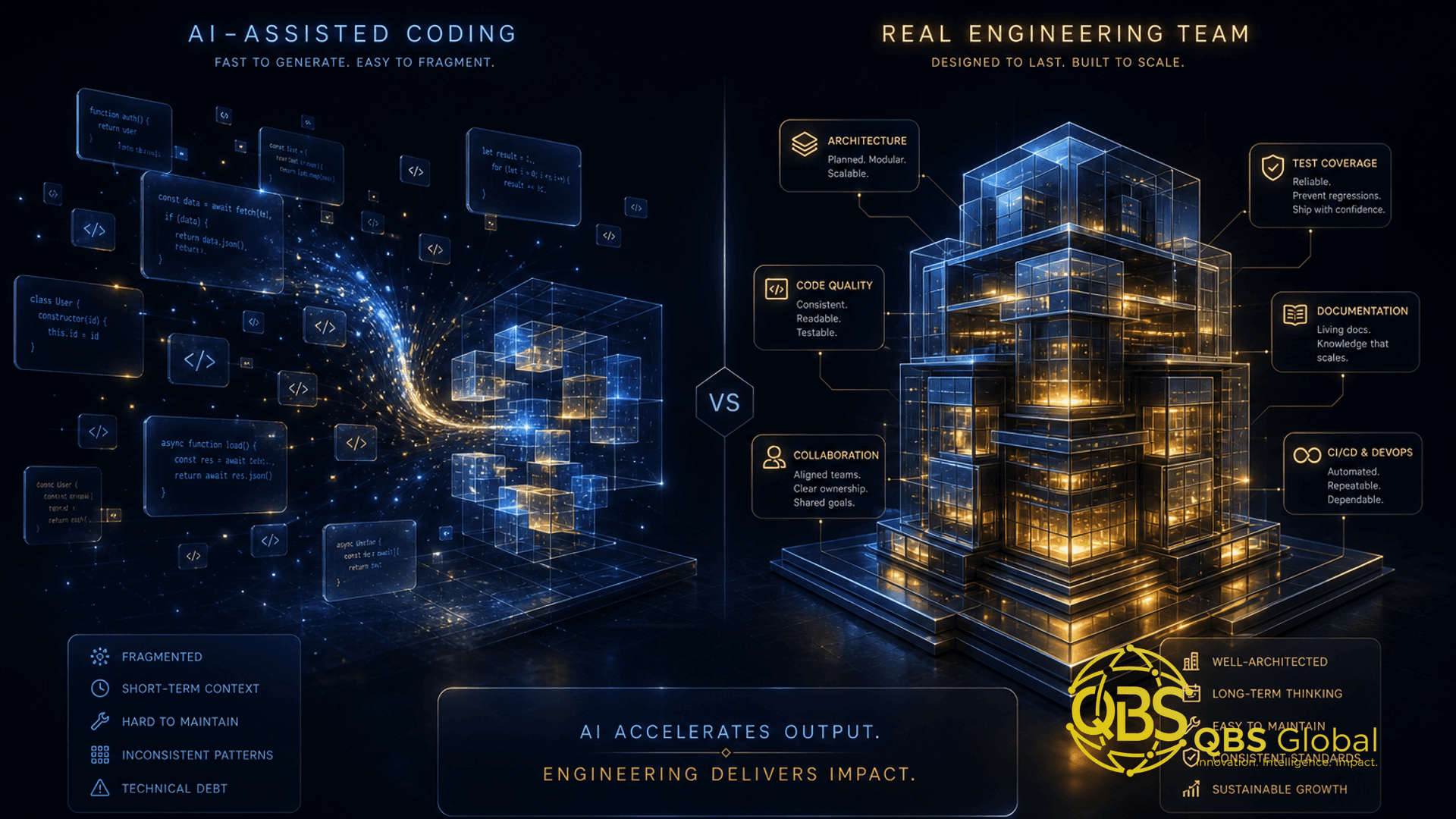
A year ago, "just build it yourself with AI" was a hopeful slogan. In 2026 it is a board-level forecast: Gartner predicts that by 2028, 40% of new enterprise production software will be built with vibe coding techniques and tools (CIO Dive). Search interest in the phrase has climbed steadily through 2025 and held into mid-2026, and the people asking the question loudest are non-technical founders deciding whether they still need to hire anyone at all.
This is the honest-broker version. We run a software and AI service line, and we'll happily tell you to vibe-code your way to a prototype before you spend a cent on developers — because for some of what you want, that's the right move. The harder, more useful question is where the approach quietly breaks, and what to do at that line. This guide is a framework you can keep using long after the news cycle moves on.
What vibe coding is and what it's genuinely good at in 2026
The term "vibe coding" was coined by Andrej Karpathy in February 2025 to describe building software by conversation — you describe what you want, an AI writes the code, and you judge it by whether it runs rather than by reading every line (Wikipedia). Tools like Cursor, Lovable, Bolt, Replit, and plain ChatGPT have turned that idea into a workflow millions of non-developers now use.
And it is genuinely good — at specific things. Here is where vibe coding earns its hype in 2026:
- Prototypes and proofs of concept. You can turn an idea into a clickable thing in an afternoon, show it to a customer, and learn whether anyone wants it before committing real money.
- Internal tools. A dashboard only your ops team uses, a script that cleans a spreadsheet, a small form that feeds a Google Sheet — low stakes, low blast radius if it breaks.
- Learning what you actually want. Founders who vibe-code a rough version write far better specs afterward, because they have felt the trade-offs firsthand.
- Glue and automation. Wiring tools together with platforms like n8n, Zapier, or Make, with AI writing the tricky transformation steps.
Takeaway: Vibe coding is the best idea-validation and internal-tooling technology we have ever had. Use it freely for those jobs. The trouble starts when a prototype quietly gets promoted to a product without anyone deciding it should be.
Where AI-generated code quietly breaks (security, scale, edge cases)
What makes vibe coding feel magical is also what makes it dangerous: the AI produces something that looks finished and runs on the happy path, so a non-technical builder gets no signal that anything is wrong. The gaps stay invisible until they're expensive.
Security is the big one. In Veracode's 2025 GenAI Code Security Report — which tested more than 100 large language models across 80 curated coding tasks — AI introduced security vulnerabilities in roughly 45% of code samples, and newer or larger models were no safer than smaller ones (Veracode / BusinessWire). Veracode's follow-up in spring 2026 found the security pass rate had not improved even as functional correctness did (Veracode). In other words: the AI is getting better at making code work and no better at making it safe.
This is not theoretical. When the security firm Escape.tech scanned 5,600 publicly reachable vibe-coded applications in October 2025, it found more than 2,000 high-impact vulnerabilities, over 400 exposed secrets like API keys, and 175 instances of exposed personal data including medical records and bank details — all in live production systems (Escape.tech).
Beyond security, two quieter failure modes show up as you grow:
- Scale. Code that runs fine for 10 users can fall over at 10,000 — naive database queries, no caching, no rate limits. The AI optimizes for "works now," not "works under load."
- Edge cases. The unhappy paths — a duplicate signup, a half-finished payment, a weird timezone, a malformed upload — are exactly where AI-generated code tends to be thin, because you never thought to prompt for them.
The trap: AI-generated code fails silently. It does not throw an error that says "this is insecure" or "this won't scale." It just works in the demo and breaks in production, often months later, when a real user does something you never tested.
The 'last 20%' problem that stalls non-technical founders
Here's the pattern we see constantly. A founder vibe-codes roughly 80% of a working product in a couple of weeks, gets thrilled — then spends the next three months stuck, because the remaining 20% is the part AI is worst at and they can't do themselves.
The last 20% is almost always the same list:
- Real authentication and permissions — making sure user A can never see user B's data.
- Payments and billing — edge cases, refunds, failed charges, tax, and not leaking card data.
- Reliability — what happens when something fails halfway, and how the app recovers.
- Data integrity — migrations, backups, and not corrupting records when you change the schema.
- Deployment and uptime — getting it live, keeping it live, and fixing it at 2am when it isn't.
The cruel part is that this last slice is where most of the real engineering lives — and it's exactly where prompting hits a wall. When the AI's fix breaks something else, and that fix breaks a third thing, a non-technical founder has no way to break the loop. This is where many MVPs stall out, or limp into production carrying risk the founder can't see. If yours is already there, our guide on how to rescue a failing software project covers getting unstuck without throwing away the work.
Takeaway: Vibe coding gets you to a demo fast and then asks you to climb the hardest cliff alone. The first 80% lulls you; the last 20% is where you either bring in help or stall.
DIY-with-AI vs hiring a partner: a cost-and-risk comparison
The honest comparison is not "AI versus humans." It is AI alone versus AI plus an accountable team. Here is how the two stack up for real business software:
| Factor | DIY with AI (vibe coding solo) | Hiring a development partner |
|---|---|---|
| Upfront cost | Very low — tool subscriptions | Higher — you pay for engineering time |
| Speed to first prototype | Hours to days | Days to weeks |
| Speed to safe production | Often never, or slow and risky | Predictable, with the last 20% handled |
| Security ownership | You, and you can't see the gaps | A team accountable for hardening it |
| Handles scale & edge cases | Poorly without expertise | Designed in from the start |
| When something breaks | You're stuck in a prompt loop | Someone you can call fixes it |
| Total cost if it fails late | Can be very high (rework, breach, lost customers) | Lower risk, caught earlier |
| Best for | Prototypes, internal tools, validation | Anything customers or revenue depend on |
The trap is the first row. The monthly tool cost is low, so DIY looks cheaper — but the real number is the total cost including rework and risk. A vibe-coded app that leaks customer data, or that you have to rebuild because it can't be safely extended, costs far more than building it properly once. We break the full money side down in our honest cost-and-risk guide to outsourcing software development.
Takeaway: Use the cheapest viable tool to learn — that's good discipline. But price the decision on total cost and risk, not the subscription line. The expensive mistake is treating a prototype budget as a production budget.
How a dev partner works alongside AI coding (not against it)
A common fear is that hiring developers means throwing away your AI workflow and going back to slow, expensive, old-school engineering. That is not how it works in 2026, and any partner who tells you to start over from scratch is usually wrong.
Good engineering teams use the same AI tools you do — they just use them with judgment. The difference isn't whether AI writes the code; it's who is accountable for what the code does. In practice, a modern partner:
- Keeps the velocity. They still let AI generate the boilerplate and first draft — that part is faster for everyone.
- Reviews what the AI can't. They read the security-sensitive code, the data handling, the auth, and the money paths AI gets wrong nearly half the time.
- Owns the last 20%. Auth, payments, reliability, deployment — the cliff you were stuck on becomes their job.
- Builds it so it can change. They structure the code and tests so the next feature doesn't break the last one — the loop that traps solo vibe coders.
- Automates the busywork around the build — testing, the deploy pipeline, monitoring — so it stays alive without a human babysitting it.
Think of it as a co-pilot model: AI handles the typing, a human handles the thinking that carries real-world consequences. You don't lose speed — you lose the silent risk.
Signs it's time to bring in a real development team
You do not need a developer for every project, and you should not hire one a day too early. But there are clear, non-technical signals that you have crossed from "prototype" into "this needs engineering." If two or more of these are true, it is time:
- Real people's data is in it. Logins, payments, personal or health information — anything a breach would expose. The Escape.tech scan above is what this looks like when it goes wrong.
- Money flows through it. Billing, payouts, anything where a bug costs cash directly.
- You can't change it anymore. Every AI edit breaks something else, and you're stuck in the loop.
- Downtime would cost you. If the app going down means losing customers or revenue, it needs someone accountable for uptime.
- You're about to put marketing behind it. Driving real traffic to a fragile app exposes every edge case at once.
- You can't explain how it works. If no human understands the code — including you — you have a liability, not an asset.
Takeaway: The trigger is not complexity for its own sake. It is consequences. The moment a failure would cost real money, real data, or real customers, the economics of "do it yourself with AI" flip — and a tailored read on your specific situation beats guessing. If you're weighing a formal engagement, our guide on how to write an RFP for software development helps you scope it so you get honest quotes instead of vague ones.
A practical handoff checklist if you've already vibe-coded an MVP
If you have a working-ish app and you're ready to bring in help, do not just hand someone a login and hope. A clean handoff saves you weeks and a lot of money. Bring these to the first conversation:
- Access to the code itself — the actual repository (often on GitHub), not just the live app. If your AI tool keeps the code locked inside its platform, ask how to export it; this matters more than anything else.
- All the accounts — hosting, database, domain, payment provider, email — and admin access to each. Use a password manager, and rotate any secret you've ever pasted into a chat window.
- A plain-language description of what it does — every screen, every user type, what's supposed to happen. You don't need technical terms; you need completeness.
- The known-broken list — every bug, glitch, and "I'm not sure that's safe" you've noticed. Honesty here is gold; hiding problems just delays finding them.
- What data is in it — especially any real customer or personal data, so the team can check exposure first, before anything else.
- Your actual goal — are you scaling this to thousands of users, or do you just need it made safe and stable? That changes the whole plan.
The first thing a competent partner should do with all this is an audit, not a rebuild — a fast, honest read on what's solid, what's risky, and what the real remaining work is. Be wary of anyone who quotes a delivery date before they've looked at your code. A team that respects what you've built and only rewrites the dangerous parts will cost you far less than one that insists on starting from zero.
Takeaway: Vibe coding got you a head start — treat it as an asset to protect in the handoff, not a mess to apologize for. The right partner builds from it, not over it.
Vibe coding isn't the end of hiring developers; it's a faster on-ramp that makes the first mile cheap and leaves the hardest mile exactly where it always was. The smart play in 2026 is to use AI freely to learn and prototype, then bring in accountable engineering before customer data, money, or your reputation depend on the code — and to know where that line sits for your build.
If you've vibe-coded something and aren't sure whether it's safe to launch, scale, or hand off, book a free 30-minute call with QBS Global. We'll give you an honest read on where it stands and a tailored roadmap for the last 20% — within 48 hours.
Frequently asked questions
What is vibe coding in simple terms?+
Vibe coding is building software by describing what you want in plain language to an AI tool, which writes and edits the code for you. The term was coined by Andrej Karpathy in February 2025, and the defining trait is that you accept the AI's output based on whether it works rather than reading every line.
Is vibe coding good enough to run a real business on?+
It is good enough for prototypes, internal tools, and validating an idea, but most production business software still needs a developer to harden security, handle scale and edge cases, and own the parts AI cannot finish reliably. Use vibe coding to learn fast, then bring in engineering before you put customer data or revenue behind it.
When should I stop vibe coding and hire developers?+
Hire when the app handles real customer data, money, or logins, when you cannot fix or change it yourself anymore, when bugs reappear after each AI edit, or when downtime would cost you customers. Those are signs you have crossed from prototype into production and need someone accountable for the code.
How risky is AI-generated code for security?+
Riskier than most non-technical founders assume. Veracode's 2025 testing across more than 100 models found that AI introduced security vulnerabilities in about 45% of code samples, and a scan of 5,600 vibe-coded production apps surfaced exposed secrets and personal data. AI rarely flags these gaps on its own.
Can a development partner work with code I already vibe-coded?+
Yes. A good partner starts with an audit of your existing build, keeps what works, and rewrites only the risky parts rather than starting over. Bring your repository, accounts, and a plain-language list of what the app does, and a strong team can take over from there.
Is hiring a developer more expensive than just using AI tools?+
The tools are cheaper per month, but total cost depends on rework and risk. A vibe-coded app that leaks data or stalls at the last 20% can cost far more to fix than it would have to build properly once. The honest answer is to use AI for speed early and budget for engineering before launch.