Build vs Buy AI Agents: A Decision Framework for Service Firms and Agencies
Build vs buy AI agents for service firms — a vendor-neutral framework, 12-month cost math, and a scoring checklist you can run in an afternoon.
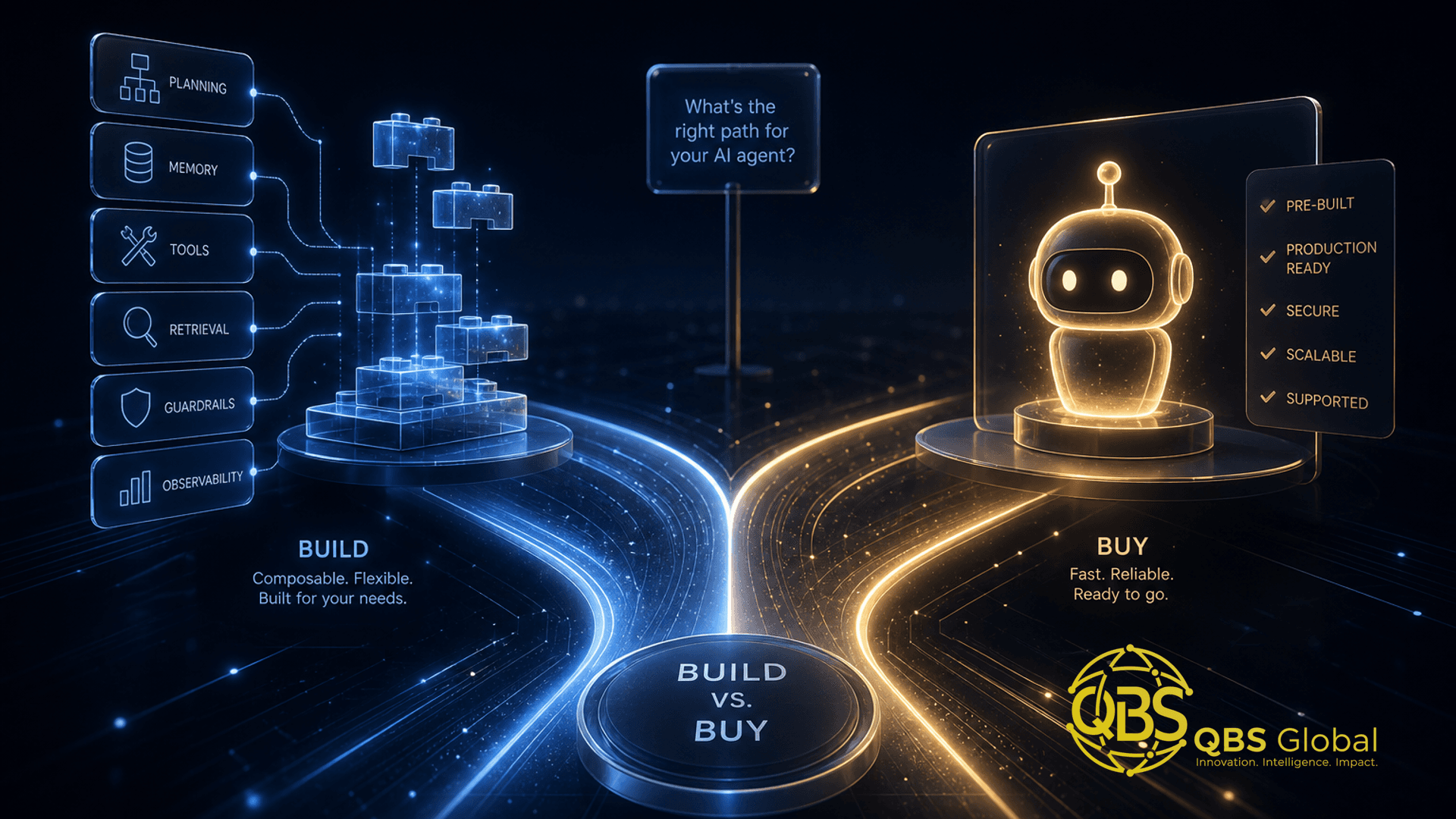
The fastest-climbing search term in B2B software right now isn't a product — it's a question. Interest in "agentic AI" went from background noise to a full-blown breakout over 2025 and into 2026, and the most common follow-up founders type is some version of should we build our own AI agent or just buy one? The hype is loud, the tooling is real, and the bill for guessing wrong is now large enough to matter.
This is the vendor-neutral, operator's answer. We run a software and AI service line, so we build agents for clients — and we also tell people to buy off-the-shelf when that's the smarter call. What follows is a framework you can run: when buying wins, when building wins, what each path costs over a year, and a scoring checklist you can finish in an afternoon. No religion, no agent-washing.
The 2026 Build-vs-Buy Question (and Why 95% of DIY AI Pilots Stall)
The debate got urgent for one reason. In its 2025 State of AI in Business report, MIT's NANDA initiative found that 95% of enterprise generative AI pilots delivered no measurable return — they stalled before reaching production. That single stat is what turned "build vs buy" from an architecture footnote into a board-level question.
Here's the part most coverage buried, and the part that should anchor your decision. In the same MIT research, purchasing AI tools from specialized vendors succeeded about 67% of the time, while internal builds succeeded only one-third as often. Bought beat built by roughly two to one. Not because building is bad — because most teams underestimate what an agent needs after the demo: data plumbing, workflow fit, edge cases, and someone who owns it forever.
The takeaway: the default for a service firm should be "buy first, build the exception." You build the one workflow that is your edge, and you buy everything else.
Why do DIY pilots stall so reliably? A few honest reasons:
- The demo lies. An agent that handles a clean happy-path case in a sandbox is maybe 20% of the work. The other 80% is the messy real world — bad inputs, exceptions, integrations, and the day the model changes its behavior under you.
- No owner. A bought tool has a vendor on the hook for uptime and updates. A homegrown agent has whoever built it — usually someone already busy with billable work.
- Hype over fit. Gartner predicts over 40% of agentic AI projects will be canceled by the end of 2027, citing escalating costs and unclear business value. Most are experiments dressed up as strategy.
None of this means "don't build." It means build deliberately, where the math and the moat justify it.
When Buying an Off-the-Shelf Agent Wins
Buying wins more often than founders expect — especially for the busywork that eats your team's week. If a capable tool already exists and the workflow isn't your differentiator, building it yourself is usually ego, not strategy.
Buy when:
- The problem is common. Meeting notes and summaries, inbox triage, first-draft proposals, scheduling, support deflection, invoice chasing, CRM data entry. Thousands of companies have the same need, so a vendor has already solved it better than you will in a sprint.
- Speed matters more than perfection. You can be live this week with a configured tool. A custom agent is weeks-to-months away, and that gap is pure opportunity cost.
- The workflow is non-core. It's valuable but it's not what clients pay you for. Automating it captures margin without building a moat — so don't spend moat-money on it.
- You lack an owner. No internal engineer who can babysit prompts, monitoring, and breakage? Buy. An unmaintained agent is worse than no agent.
- Compliance is handled for you. A serious vendor carries SOC 2, data-handling terms, and an audit trail. Reproducing that yourself is a project in itself.
Generic platforms like ChatGPT and Claude for drafting, n8n or Zapier for orchestration, and a growing field of vertical assistants cover an enormous amount of ground for a monthly fee. The market is exploding precisely because buying works: analysts project the AI agents market will grow from roughly $7.84 billion in 2025 to $52.62 billion by 2030 — most of that is tools being bought, not built.
Bought also doesn't mean dumb. The skill is orchestration: stitching three or four bought agents into one workflow that fits how you work. That's where a service partner earns their keep — and it's the same instinct behind knowing when to outsource software development versus keep it in-house.
When You Should Build (Data, Workflow, Lock-In, Margin)
Building is the right call less often — but when it's right, it's really right. Four signals tell you you've crossed the line from "buy" to "build."
1. The workflow is your competitive edge. If the agent is the product — the thing clients can't get anywhere else — you can't rent it. A bought tool gives your competitors the same capability for the same monthly fee. Custom logic that encodes your firm's hard-won method is worth owning.
2. Your data or process is genuinely unique. Off-the-shelf agents are trained on the average company. If your value comes from a proprietary dataset, an unusual workflow, or domain knowledge no vendor models, a generic tool will be mediocre at exactly the thing that matters most.
3. Lock-in or compliance forces your hand. When a vendor holds your data hostage, can't meet a client's security requirement, or won't integrate with a system you depend on, building buys you control. Sometimes a client contract simply requires it.
4. Margin math flips. This is the quiet one. Per-seat and per-action SaaS pricing is cheap at 5 seats and brutal at 500. When usage is high and sustained, a one-time build plus hosting can beat a forever-subscription — the same logic that drives the cost-to-build-a-custom-CRM decision. Run the 12-month number before you assume buying is cheaper.
Rule of thumb: Build the agent that makes you money. Buy the agent that saves you time.
One caution: building isn't a one-time cost. An agent you build is a product you now maintain — prompts drift, models change, integrations break, and someone has to own it. If you can't name that owner, you're not ready to build.
The Hidden Costs of Each Path Over 12 Months
Headline prices lie. A "$50/month" tool and a "$15,000 build" are not what they cost — the real number includes everything around them. Here's the honest 12-month view for a single meaningful workflow at a small service firm.
| Cost driver | Buy (off-the-shelf) | Build (custom) |
|---|---|---|
| Upfront / setup | Low — config and onboarding | High — scoping, design, development |
| Monthly run cost | Per-seat or per-action subscription, scales with usage | Hosting + model API tokens (usage-based) |
| Integration work | Some — connect to your stack | Significant — you own every connection |
| Maintenance | Vendor handles updates and uptime | You own prompts, breakage, model changes |
| Time to value | Days to a couple of weeks | Weeks to months |
| Switching / exit cost | Lock-in risk; data may be hard to export | You own it; portable but you maintain it |
| Risk if it fails | Cancel the subscription | Sunk build cost |
Hidden costs of buying: usage-based pricing that quietly scales past your forecast, the integration glue nobody quotes, vendor lock-in, and the day the tool gets acquired and sunset. The subscription is the floor, not the ceiling.
Hidden costs of building: the 80% of work after the demo, the engineer you pull off billable work, model and token costs that move, and the permanent maintenance line. The build quote is the start of spending, not the end.
The honest comparison isn't price — it's total cost of ownership over the period you'll actually use the thing. A bought tool that's live in a week and "good enough" usually beats a custom build that's perfect in three months but late, over budget, and now your problem to maintain — until volume and differentiation flip the math. The trap is assuming you know which side you're on without running the numbers.
A Scoring Framework You Can Run in an Afternoon
You don't need a consultant to make this call. Score the specific workflow — not "AI" in the abstract — on these seven questions. Each is 0 to 3. Tally the total.
- Is this workflow our competitive edge? (0 = pure busywork, 3 = clients pay us for this)
- Is our data or process genuinely unique here? (0 = totally standard, 3 = proprietary)
- Does a good off-the-shelf tool already exist? (0 = several mature options, 3 = nothing fits)
- Is the volume high and sustained? (0 = occasional, 3 = constant, heavy usage)
- Do we have an owner who can maintain a build? (0 = nobody, 3 = a dedicated engineer)
- Does lock-in or compliance force a custom path? (0 = no constraint, 3 = hard requirement)
- Can we tolerate weeks-to-months before value? (0 = need it now, 3 = no rush)
Reading the score:
- 0–8 → Buy. Configure an off-the-shelf agent and move on. Building here burns money and time you won't get back.
- 9–14 → Buy now, build later. Start bought to capture value, instrument it, and revisit building once you've proven the workflow matters. (More on this below.)
- 15–21 → Build. The differentiation, data, volume, or constraints justify owning it. Make sure you've named the owner before you start.
Run this per workflow, not per company. A single firm will correctly buy its meeting notes agent and build its proprietary client-scoring agent. The answer is almost never "build everything" or "buy everything" — it's a portfolio. If you're putting real budget behind a custom build, treat it like any other software project and write a proper RFP first so you're comparing partners on the same scope.
How Service Firms and Agencies Should Decide Differently Than Enterprises
Most build-vs-buy advice is written for enterprises — companies with a platform team, a data lake, and a budget for a failed pilot. If you're a service firm or agency, your constraints are different, and the default should tilt harder toward buying. Here's why.
You have thinner margins. A failed enterprise pilot is a rounding error. For a 12-person agency, a $40,000 custom agent that doesn't ship is a real wound. Enterprises optimize for capability; you optimize for survival-adjusted ROI. Buy first, prove value, reinvest.
You don't have a platform team. Enterprises have engineers whose whole job is internal tooling. You have engineers who are billable — every hour they spend maintaining an internal agent is an hour not earning revenue. That changes the build math completely.
Your data advantage is smaller. Enterprises have proprietary datasets that make custom models genuinely better. Most service firms don't — which means a bought tool trained on the average company is often as good as what you'd build, at a fraction of the cost.
But your client work can be a real moat. Here's the flip: the one place a service firm should build is client-facing IP — an agent that makes your delivery faster, cheaper, or better than competitors who are all renting the same tools. That's not a cost center; it's how you win deals.
| Factor | Enterprise instinct | Service-firm reality |
|---|---|---|
| Cost of a failed pilot | Absorbable | Painful — bias toward buy |
| Internal engineering | Dedicated platform team | Billable engineers — building costs revenue |
| Data moat | Often real | Usually thin — buy is competitive |
| Where to build | Internal efficiency | Client-facing IP and delivery edge |
| Speed pressure | Quarters | Weeks — clients are waiting now |
The agencies winning with AI right now aren't the ones who built everything. They're the ones who bought fast, orchestrated cleverly, and built only the workflow that makes their service visibly better — the same discipline behind deploying AI sales agents at a small business without over-engineering. Adoption is already widespread, so the edge isn't using AI — it's deciding correctly where to build.
What 'Buy Now, Build Later' Looks Like in Practice
For most service firms, the right answer to "build or buy" is both — in sequence. Buy to capture value today, build the high-value pieces once you've earned the right. Here's the playbook.
Step 1 — Buy the obvious wins this month. Pick the two or three busywork workflows draining your team and configure off-the-shelf agents for them. Get to value in days, not quarters. This funds and de-risks everything that follows.
Step 2 — Instrument everything. Track how often each agent runs, where it breaks, where humans override it, and how much time it actually saves. You're collecting the data that will later tell you which workflow is worth building — and giving you the requirements you'd otherwise guess at.
Step 3 — Find the workflow that's outgrowing its tool. Watch for the signals: usage so high the per-seat bill stings, a vendor limitation you keep working around, or a workflow that's quietly become your differentiator. That's your build candidate — now backed by real evidence, not a hunch.
Step 4 — Build that one thing properly. With proven requirements and a clear owner, commission a custom agent for the workflow that earns it. Because you bought first, you're building from data instead of from optimism — which is exactly why this path dodges the 95% stall.
Step 5 — Repeat per workflow. Re-score periodically. As you grow, more workflows cross from buy into build. The portfolio shifts over time; it's never a one-time decision.
This is why "build vs buy" is a false binary. The real question is sequencing and orchestration — buy to move fast, instrument to learn, build where it counts, and keep the seams between bought and built tools clean. That orchestration layer is where a service partner adds the most value, and it's the work that quietly compounds.
If you're staring at this decision for your own firm and want a straight answer rather than a sales pitch, that's exactly the kind of thing we help with. Book a free 30-minute call with QBS Global and we'll map your workflows to a buy-first, build-where-it-counts roadmap — and send you a tailored version within 48 hours, whether or not you ever work with us.
Frequently asked questions
Should a service firm build or buy AI agents in 2026?+
For most service firms the honest default is buy first, then build only the one or two workflows that are your competitive edge — MIT's 2025 research found bought tools succeeded about 67% of the time versus roughly half that for internal builds.
Why do so many in-house AI agent projects fail?+
MIT found 95% of enterprise generative AI pilots delivered no measurable P&L impact, mostly because teams underestimate workflow fit, data plumbing, and the ongoing maintenance an agent needs once it touches real client work.
When does building your own AI agent actually make sense?+
Build when the workflow is your core differentiator, when your data or process is genuinely unique, when off-the-shelf tools force painful lock-in, or when the volume is high enough that per-seat SaaS pricing destroys your margin.
What are the hidden costs of buying an AI agent?+
Per-seat or per-action pricing that scales with usage, integration and data-cleanup work, vendor lock-in, switching costs, and the risk that a tool you depend on changes pricing or gets acquired and sunset.
What is a 'buy now, build later' AI strategy?+
You buy off-the-shelf agents to capture value immediately, instrument everything so you learn which workflows matter, and only rebuild the highest-value, highest-volume pieces in-house once the economics and requirements are proven.
How should agencies decide differently than enterprises on AI agents?+
Agencies have thinner margins, less data, and no platform team, so they should lean harder toward buying and orchestration, reserve building for client-facing IP, and treat any internal build as a service line that needs ongoing ownership.