How Often Should You Post on Each Platform in 2026? A Posting-Cadence Guide for Service Businesses
Proven 2026 ranges for LinkedIn, Instagram, TikTok, X and Facebook, plus a two-hour weekly schedule a one-person service firm can actually keep.
You sat down on Sunday and mapped out a posting plan. Daily on Instagram, three times a week on LinkedIn, a TikTok whenever inspiration struck. By Wednesday a client emergency ate the afternoon you'd blocked for content, and by the following week the whole thing had quietly collapsed. Sound familiar? You're not lazy or disorganized. You're a service business owner who was handed a content cadence built for full-time creators, not for someone running delivery, sales, and operations at the same time.
The real question isn't "how often can you post." It's "how often must you post to stay visible, without it becoming the thing that breaks every week." This guide answers that for 2026 with platform-by-platform numbers, a realistic weekly schedule, and an honest line for when posting frequency stops being something you should do yourself at all.
Cadence Myths That Waste a Small Firm's Time
Most posting advice is written by and for people whose entire job is posting. When a service firm adopts it wholesale, three myths quietly drain hours.
Myth 1: "You have to post every day or the algorithm punishes you." No major platform requires daily posting to keep you visible. What the data actually rewards is consistency relative to your own baseline. Buffer's analysis of more than 2 million LinkedIn posts found the largest efficiency gain came from moving off a once-a-week habit to a steady 2-to-5-per-week rhythm — not from grinding to a daily cadence (Buffer, 2 million+ LinkedIn posts).
Myth 2: "More posts always mean more growth." More can help, but with sharply diminishing returns — and only if quality holds. The same Buffer LinkedIn data shows the jump from one to 2-to-5 posts per week added roughly 1,182 impressions per post; the gains keep climbing at higher volumes but the effort-to-reward ratio gets worse, not better. For a team of one, the efficient zone is the early end of that curve, not the top.
Myth 3: "If I'm not posting, I'm falling behind." What actually hurts you is erratic posting — a flurry one week, silence for three. A predictable two-a-week reads as a healthy, active account to both humans and ranking systems. An unpredictable burst-then-vanish pattern does not.
The takeaway: stop measuring yourself against creators. Measure against your own last month, and against a cadence you can hold through a busy quarter.
Platform-by-Platform 2026 Cadence Table
Here's where the proven 2026 ranges actually land. These come from platform-specific studies and a survey of 100-plus working social media managers, not from gut feel.
| Platform | Recommended cadence (2026) | What the data says | Best for service firms when... |
|---|---|---|---|
| 2–5 posts/week (2–3 is plenty) | 2–3x/week is the most common pro cadence; moving from 1 to 2-5 added ~1,182 impressions/post | You sell B2B services to operators, founders, or HR/finance buyers | |
| 3–5 feed posts/week + Reels as bandwidth allows | Most managers post 2–5x/week; consistency beats daily volume | You're visual, local, or trust-led (design, trades, hospitality, coaching) | |
| 3–5 posts/week | 2–5x/week is the working norm; over-posting triggers scroll-past | Your buyers skew 35+ or you run local/community offers | |
| X (Twitter) | 3–7 posts/week (higher tolerance for volume) | Faster-moving feed rewards more frequent, lighter posts | You comment on industry news or run founder-led thought leadership |
| TikTok | 3–5 short videos/week | Going from 1 to 2-5/week gave up to 17% more views per post | You can produce short video and want reach over a younger/SMB audience |
Sources: Buffer's LinkedIn study (2M+ posts), Buffer's TikTok study (11.4M posts), and HeyOrca's 2026 frequency survey of 100+ social media managers.
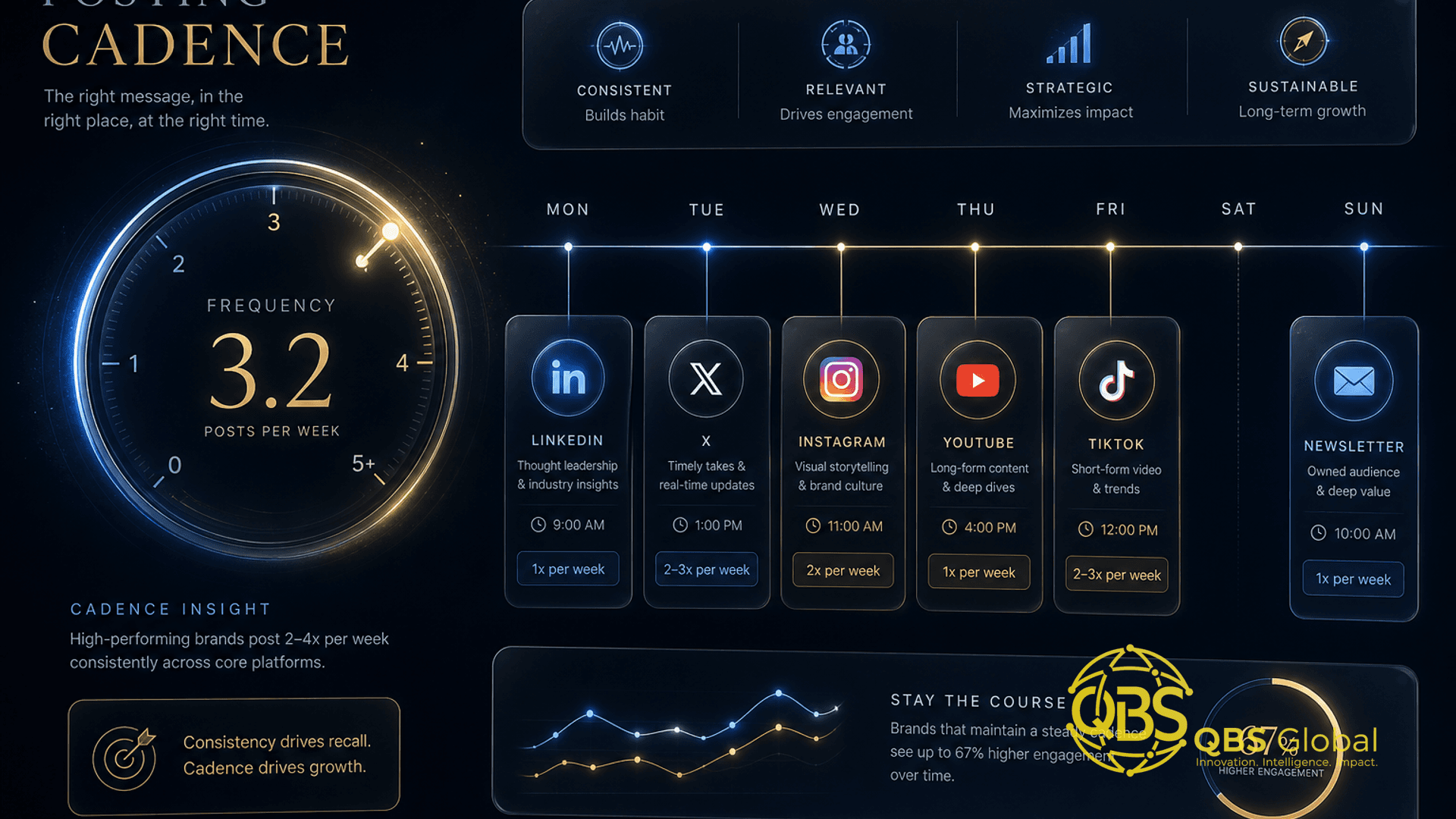
The pattern across every platform is the same: 2-to-5 per week is the consensus sweet spot. Daily is optional, reserved for teams with real production capacity. Nobody serious is telling small firms they must post seven times a week on every channel.
The Minimum Viable Cadence for a Time-Poor Service Firm
If you take one number from this article, take this: one platform, two posts a week, never missed.
That's the floor — and for a lot of service businesses, the floor is exactly where you should start. Here's the logic. Across small businesses, roughly half have no employee dedicated to marketing at all and a majority run on monthly marketing budgets under $1,000, yet unpaid social media is the single most-used marketing channel (LocaliQ Small Business Marketing Trends Report). Translation: you're competing on a channel everyone uses, with less time than almost anyone, and the deciding factor is who shows up reliably.
A minimum viable cadence works because it's defendable under pressure. When a deal closes or a client escalates, a two-a-week commitment survives. A five-a-week-across-three-platforms plan does not. And a surviving small cadence compounds; an ambitious one that collapses every month resets to zero.
How to set your floor:
- Pick one platform where your actual buyers are. B2B services → LinkedIn. Local or visual → Instagram. Don't split a thin budget of attention across five channels.
- Commit to two posts per week, on fixed days (say Tuesday and Thursday). Fixed days remove the daily "should I post?" decision that eats willpower.
- Hold that for 30 days before adding anything. Only once two-a-week is automatic do you add a third slot or a second platform.
This is unglamorous, and that's the point. The firms that win on social aren't the most creative — they're the ones still posting in month nine.
A Realistic Weekly Posting Schedule
Here's what a sustainable week looks like for a service firm with one platform as the anchor and a second as a stretch. The goal is a schedule you could run during your busiest week of the quarter, not your calmest.
| Day | Primary (LinkedIn) | Stretch (Instagram/TikTok) | Time cost |
|---|---|---|---|
| Monday | — (plan + draft for the week) | — | 30 min batching |
| Tuesday | Post 1 — insight or how-to | — | 10 min to publish |
| Wednesday | — | Reel/short repurposed from Tue post | 15 min |
| Thursday | Post 2 — client problem + your take | — | 10 min |
| Friday | — | Story/short or carousel from the week | 15 min |
| Weekend | Off | Off | — |
That's two anchor posts plus two repurposed shorts a week — squarely inside every platform's recommended range — for well under two hours of work, most of it front-loaded into one Monday batching block. Note what makes it survivable: no daily obligation, fixed publish days, and the "stretch" content is recycled from the anchor posts, not invented from scratch. If the stretch row falls off during a brutal week, your account still looks healthy on the two anchor posts alone.
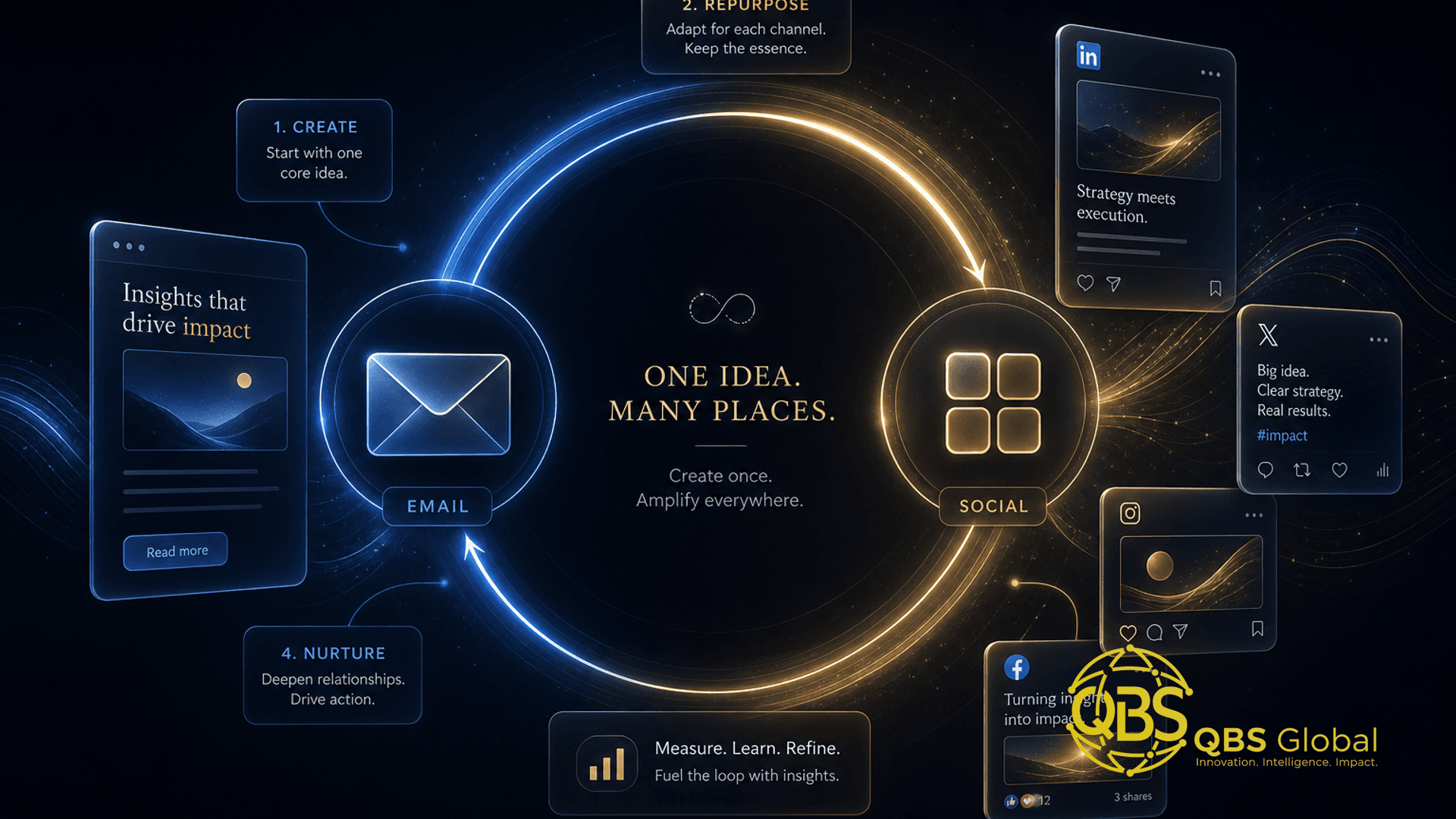
This is also where a tight loop between your channels pays off. If you're already writing a weekly client email or newsletter, that copy is the raw material for your social posts and vice versa — a system we break down in building an email-and-social content loop for service firms.
Quality vs Frequency: Where the Line Really Is
The eternal debate is usually framed wrong. It's not quality versus frequency — it's "what's the minimum quality bar that lets frequency actually work."
Here's the honest line. Frequency without a quality floor backfires. Posting more low-value content drags down your average engagement rate, which trains the algorithm to show your next post to fewer people. So volume isn't free; bad volume actively costs you. But the inverse trap is just as real: perfectionism that produces one immaculate post a quarter loses to a competitor posting solid-not-perfect content twice a week.
The resolution most service firms miss: your quality bar should be "genuinely useful to one specific buyer," not "polished like an agency campaign." A 90-second video of you explaining why clients' projects run late, shot on a phone, outperforms a glossy graphic that says nothing. Useful and frequent beats beautiful and rare.
A practical filter before you publish: would a single ideal client screenshot this or save it? If yes, it clears the bar — ship it. If it's just noise to fill a slot, skip it and protect your engagement rate. That filter lets you post often and keep quality high, because it kills the filler without demanding perfection.
How Batching and Repurposing Make Cadence Sustainable
The reason most service firms fail at cadence isn't the posting — it's the deciding and creating, fresh, every single day. Kill that, and consistency stops being a willpower problem.
Batching means producing a week (or month) of content in one focused block instead of scrambling daily. One two-hour Monday session that yields four posts beats four interrupted 30-minute scrambles, because you avoid the context-switching tax of re-entering "content mode" four separate times. Batch the creation; let a scheduler handle the publishing on your fixed days.
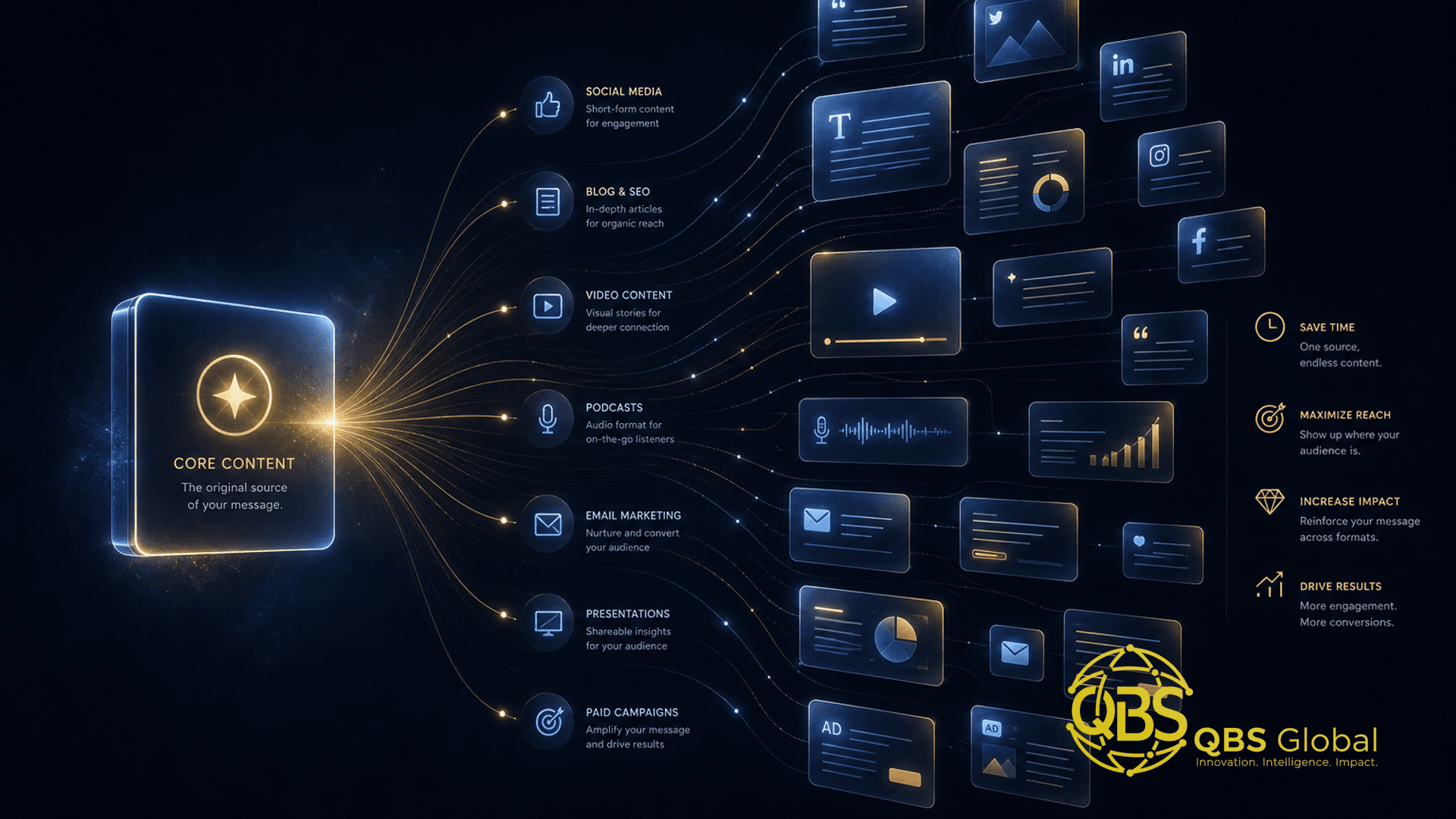
Repurposing is the real multiplier. One substantial idea — a client question you answered well, a lesson from a project — can become a LinkedIn post, a short video, a carousel, an email section, and three reply-comments. You're not generating five ideas a week; you're generating one strong idea and reshaping it five ways. That's how a two-hour week produces a full content calendar. We lay out the full mechanics of this in our guide to a content repurposing system for service businesses, and you can see it applied to a specific niche in this 30-day social media system for real estate agents.
The mindset shift: stop thinking in "posts" and start thinking in "source material." Your job isn't to write five posts; it's to capture one good idea and feed a repurposing machine. That's the difference between cadence as a grind and cadence as a system. Generic tools like a scheduler, a notes app, and an AI assistant for drafting variations can run most of this — the constraint is rarely software, it's having a repeatable process and the time to feed it.
When Your Cadence Goals Mean It's Time to Outsource
There's a clear point where doing this yourself stops being thrift and starts being a tax on growth. Watch for these signals:
- Your target cadence keeps losing to client work. If "I'll post when things calm down" has been true for two months, things won't calm down. The cadence is the casualty, every time.
- Posting has flatlined. A dormant account erodes trust faster than no account. Prospects who check your feed and see a four-month gap quietly downgrade you.
- The opportunity cost no longer makes sense. If two hours of your time is worth more in delivery or sales than a managed content service costs, you're losing money by keeping it in-house. For a founder billing real rates, that math flips fast.
- You've hit the ceiling of what one untrained person can do. Strategy, writing, design, video editing, and scheduling are genuinely different skills. Expecting one busy founder to be excellent at all five is the root cause of most stalled accounts.
Outsourcing here doesn't mean handing your brand to a faceless agency that posts stock quotes. It means putting the production engine — the batching, repurposing, scheduling, and consistency — with a dedicated team, while you keep approval and voice. For service firms doing this cost-effectively, an offshore or distributed model often delivers the reliability without the in-house overhead; we cover the tradeoffs in how to outsource social media to an offshore team.
The decision rule is simple: if your consistency depends on having a good week, your system is broken, and it's time to hand the engine to someone whose good week is guaranteed.
The honest answer to "how often should I post in 2026" is: often enough to stay visible, consistently enough to compound, and never so ambitiously that it collapses the first busy week. For most service firms that means two to five quality posts a week on one or two platforms, run on a batched, repurposed system. If figuring out your specific cadence — or building the engine to sustain it — is the part that keeps slipping, book a free 30-minute call with QBS Global and we'll map a realistic posting roadmap tailored to your firm within 48 hours.
Frequently asked questions
How often should a service business post on social media in 2026?+
For most service firms, 3 to 5 quality posts per week across one or two primary platforms is the sustainable sweet spot. Buffer's data shows the biggest gains come from moving off a once-a-week cadence to a consistent 2-to-5-per-week rhythm, not from posting daily.
Is it better to post more often or post higher-quality content?+
Both matter, but for a small team consistency beats raw volume. Three strong posts a week, every week, outperform a daily run that you abandon after a month. Quality protects engagement rate while consistency builds the algorithmic trust that frequency alone cannot.
How often should I post on LinkedIn as a B2B service firm?+
Two to five posts per week is the proven range. Buffer's analysis of over 2 million posts found that moving from one post a week to 2-to-5 added roughly 1,182 impressions per post. For most B2B founders, two to three thoughtful posts weekly is realistic and effective.
How often should I post on TikTok or Instagram Reels?+
On TikTok, going from one post a week to 2-to-5 delivered up to 17% more views per post in Buffer's study of 11.4 million posts. Three to five short videos per week is a strong target if you have the production bandwidth; otherwise prioritize consistency over chasing daily uploads.
What is the minimum viable posting cadence if I have almost no time?+
Pick one platform where your buyers actually are, and commit to two posts per week without fail. A reliable two-a-week beats an ambitious five-a-week you cannot sustain. Once that habit holds for a month, add a second platform or a third weekly slot.
When does it make sense to outsource social media instead of doing it in-house?+
When your target cadence consistently loses to client work, when posting has stalled for weeks, or when the opportunity cost of your own time exceeds what a managed team costs. If staying consistent depends on a good week, it is time to hand the production engine to someone else.