Social Media for Real Estate Agents That Actually Generates Listings: A 30-Day Content System
A social media content system for real estate agents: 5 pillars, a 30-day calendar, and a DM flow that turns followers into listing appointments.
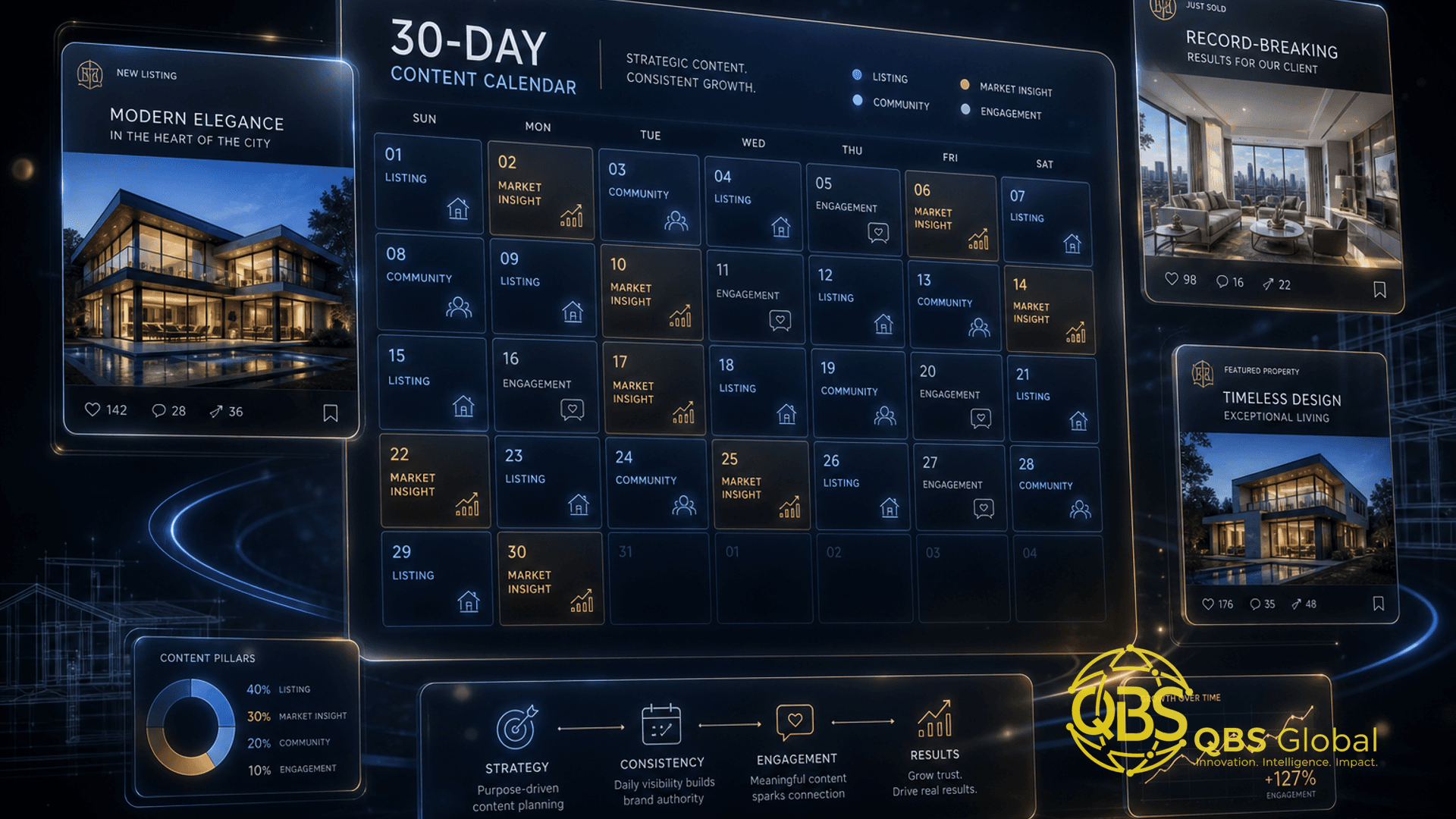
Most real estate agents are not bad at social media because they post the wrong thing. They are bad at it because there is no system underneath the posting. One week it is three listing photos, then a motivational quote, then silence for nine days, then a panicked "just sold!" graphic. The feed looks busy and produces nothing — no saved DMs, no valuation requests, no calls.
This article gives you the system that fixes that: five content pillars, a 30-day calendar you can run on repeat, and a DM-and-CTA flow that turns a passive follower into a booked listing appointment. It runs in about two hours a week and is structured so the day you hand it to a team, the handoff is clean. No fluff — the actual mechanics.
Why most agent social media never produces a single listing
The audience is real. According to NAR's 2024 Profile of Home Buyers and Sellers, 88 percent of home buyers used a real estate agent to purchase their home, and 90 percent of sellers used one to sell. The question is never whether people need an agent — it is whether they remember you at the moment they decide to move.
Social media is genuinely good at being that reminder. In NAR's REALTORS Technology Survey, social media was the top-ranked source of quality leads at 39 percent, ahead of CRM at 23 percent and the local MLS at 17 percent. The channel works. The problem is execution, and it comes down to three failures.
Failure one: no consistency. Posting in bursts and then disappearing is the single most common pattern, and it is exactly the rhythm every platform punishes. The algorithm rewards reliability; an audience rewards familiarity. Both starve when you go quiet.
Failure two: no destination. Most agent posts are admiring, not converting. A pretty listing photo with the caption "another beautiful home" gives the viewer nowhere to go. There is no question to answer, no offer to take, no reason to message you. A post without a next step is a dead end no matter how good the photo is.
Failure three: no local authority. Buyers and sellers do not hire the agent with the prettiest grid. They hire the one who clearly knows their street, their school district, their price band. Generic content — recycled memes, national rate takes — signals you could be anywhere, which is the same as nowhere.
The fix is not "post more." It is to post on a fixed rotation, anchored to your specific market, with every post pointing at a conversation. That is what the rest of this is.
The 5 content pillars that build local authority
A pillar is a category of post you return to on a schedule. Five is the right number: enough variety that the feed never feels repetitive, few enough that you never run out of ideas. Every post you make should belong to one of these.
Pillar 1 — Local authority. You, explaining your market. Neighborhood tours, "what $500,000 buys in [your area] right now," days-on-market trends for a specific zip code, a new coffee shop opening on Main Street. This is the pillar that makes you the obvious local expert and it should be the largest share of your output.
Pillar 2 — Listings and the work. Your actual inventory and transactions, but framed as stories, not flyers. The kitchen renovation that closed the deal, the price-drop that finally got it sold, a walkthrough of what makes this specific home different. Listings are content; most agents just present them as classified ads.
Pillar 3 — Education. Answer the questions buyers and sellers are quietly Googling. How earnest money works, what a contingency is, how to prep a house for photos, the three things that tank an appraisal. Education content gets saved and shared, which is what extends your reach beyond your existing followers.
Pillar 4 — Social proof. Closings, keys-in-hand moments, the story behind a happy outcome (with permission). This is the pillar that quietly answers "is this person any good?" Do not fabricate it — real proof, real people, or skip it.
Pillar 5 — Personality. You, as a human. Why you got into real estate, a behind-the-scenes of a chaotic showing day, your honest opinion on an overpriced listing down the road. People hire people, and this pillar makes the relationship feel started before you have ever spoken.
| Pillar | What it does | Rough share of posts |
|---|---|---|
| Local authority | Makes you the area expert | 30% |
| Listings & the work | Shows proof of activity | 25% |
| Education | Earns saves and shares | 20% |
| Social proof | Answers "are they good?" | 15% |
| Personality | Builds the relationship | 10% |
The 30-day posting calendar (week by week)
Here is the rotation. The target is four to five feed posts a week plus daily stories, with two or three of those feed posts being short-form video. That cadence is sustainable for a solo agent and dense enough to stay visible. You are not chasing volume — you are chasing reliability.
Week 1 — Establish authority
- Mon: Local authority — "What's happening in [neighborhood] this month" (market snapshot, short video)
- Wed: Education — answer one common buyer question (carousel)
- Fri: Listing — feature a current listing as a story, not a flyer (video walkthrough)
- Sat: Personality — a behind-the-scenes from your week (story-style reel)
- Stories daily: polls, this-or-that on home features, a quick market stat
Week 2 — Prove activity
- Mon: Local authority — neighborhood spotlight or "what $X buys here right now"
- Wed: Social proof — a recent closing story (with permission)
- Fri: Education — a seller-focused tip (how to prep for listing photos)
- Sat: Listing — price improvement or new listing announcement
- Stories daily: showing clips, a saved question from your DMs, a countdown to an open house
Week 3 — Deepen trust
- Mon: Education — explain one piece of the process that scares people (closing costs, contingencies)
- Wed: Local authority — local business feature or "best of [area]" list
- Fri: Listing — under-contract or just-sold, told as the story of how it happened
- Sat: Personality — your honest take on a market trend or a common myth
- Stories daily: a day-in-the-life, a quick answer to a follower question, a poll
Week 4 — Convert attention
- Mon: Local authority — month-in-review market update for your zip code
- Wed: Social proof — testimonial or keys-in-hand moment
- Fri: Education — a clear, direct "thinking of selling this year? Here's where to start" post with a real CTA
- Sat: Listing or open-house promotion
- Stories daily: open-house promotion, DM-me prompts, recap of the month
By the end of 30 days you have run all five pillars several times, posted roughly 18 to 20 feed pieces, and trained your audience to expect you. Then you start again at Week 1 — the calendar is a loop, not a sprint. The themes repeat; the specifics (this month's data, this week's listing) keep it fresh.
Turning listings and closings into scroll-stopping posts
This is where most agents leave the most value on the table. A listing is not one post — it is a week of content. A closing is not a graphic — it is a story with a beginning and an end.
Stop posting the flyer. "3 bed, 2 bath, $475,000" is data, not content — nobody stops scrolling for a spec sheet. Lead with the human angle: the problem this home solves, the detail that makes it special, the buyer it is perfect for. "The house for the family that outgrew their starter home but won't leave the school district" beats any bullet list of features.
Use short-form video, deliberately. Across real estate accounts, Reels generate substantially more engagement than static image posts, and walkthrough video is the format the platforms push hardest right now. You do not need a videographer — a steady phone walkthrough with on-screen text and a verbal hook in the first two seconds beats a polished slideshow.
One listing, multiple posts. Here is the repurposing math that gives you a week of content from a single property:
| Asset from one listing | Post format | Pillar |
|---|---|---|
| Full walkthrough | Reel | Listings |
| Best single room | Photo + story-led caption | Listings |
| "What I'd change" honest take | Talking-head reel | Personality |
| A feature that surprised you | Story poll | Education |
| Just-listed announcement | Feed graphic | Listings |
The same logic applies to a closing: the search story, the obstacle you solved, the keys-in-hand reel, and the lesson for other buyers are four distinct posts from one transaction. For a deeper framework on stretching one asset across two weeks, our content repurposing system for service businesses translates directly to real estate.
Lead capture: the CTA and DM flow that converts followers
A follower is not a lead. The bridge between the two is a deliberate call to action and a DM flow that turns a comment into a booked appointment. This is the part the pretty-grid agents skip, and it is the only part that produces listings.
Every converting post ends with one clear instruction. Not "let me know if you have questions" — that is passive and nobody acts on it. Use a specific, low-friction ask: "Comment SELLER and I'll send you my pre-listing checklist," or "DM me your zip code for what your home is worth in today's market." The word-trigger does two jobs: it boosts the post (comments signal the algorithm) and it gives you a warm, self-identified lead in your inbox.
The DM flow is a sequence, not a sales pitch. When someone replies to the trigger, run this:
- Deliver the promise immediately. Send the checklist, the value, the answer — no strings. Reciprocity opens the door.
- Ask one qualifying question. "Are you thinking of selling this year, or just keeping an eye on values?" One question, easy to answer, tells you everything about timing.
- Offer the next step, framed as help. "Happy to do a quick no-obligation valuation on your place if it's useful — takes me 15 minutes." You are offering a free, specific thing, not asking for a commitment.
- Move it off the platform. Get to a call or a calendar link. The DM is the handoff point, not the destination.
Mirror the long-game channel. Referral partners and relocation buyers increasingly live on LinkedIn, where the relationship-first DM approach works without paying for ads — the same way we lay out in our guide to LinkedIn lead generation without ads. Cross-posting your authority content there compounds the effect.
The single highest-leverage change most agents can make: add one specific CTA to one post per week and actually run the DM sequence when people respond. That alone separates feeds that generate listings from feeds that generate likes.
Tools and batching: a 2-hour-a-week production system
The reason this is sustainable is that you do not do it daily. You batch it. The enemy is the every-morning "what should I post today" decision — that is where the hours and the willpower leak out. The calendar already answered that question, so production becomes mechanical.
Here is the two-hour weekly block, split into three sessions:
| Block | Time | What you do |
|---|---|---|
| Film | 45 min | Record 3–4 short videos in one sitting — walkthroughs, talking-head tips, a personality clip |
| Write & design | 45 min | Draft all captions for the week, build any graphics or carousels |
| Schedule | 30 min | Load everything into a scheduler, set times, queue stories |
The tools are commodity and mostly free. A phone and a small tripod for filming. A free template editor like Canva for graphics. A scheduler — Meta's own Business Suite is free, or a tool like Buffer or Later for one queue across platforms. And a simple note or board for your content ideas so nothing gets invented from scratch.
Where automation earns its place. Use AI tools to draft caption first-drafts from your bullet points, to generate carousel copy, and to repurpose one long video into several short clips with auto-captions. Keep a human — you — on the hook, the angle, the on-camera moments, and every DM that speaks for your business. Automate the mechanical, never the relationship.
The discipline that makes batching work: decide once, execute many. When the calendar tells you Monday is a local-authority video, you are not deciding anything on Monday — you filmed it last week. That removed decision is where the two-hour math actually comes from.
When to outsource the whole thing
There is a point where doing it yourself stops being the smart move. For most agents it arrives the moment the system is proven but your calendar is full of actual selling — showings, negotiations, closings. The content is working, and now your own time is the bottleneck. That is the signal to hand it off.
Outsource in this order, and only once the system runs:
- First, the production. Filming edits, caption writing, graphic design, and scheduling. These are mechanical and eat the most hours. A team can run your existing calendar without needing your judgment on every post.
- Second, first-line DM triage. A trained assistant or team can deliver the lead magnet, ask the qualifying question, and book the call — escalating real opportunities to you. You keep the sales conversation; they keep the inbox warm.
- Never, the strategy or your face. The pillars, the market take, the on-camera moments, and the actual sales call stay with you. Those carry your voice and your license.
A word of caution: outsourcing a broken system just produces more posts nobody acts on. If there is no calendar, no CTA, no DM flow, a vendor will hand you a prettier version of the same dead end. Prove the loop yourself for 60 to 90 days first — then hand a working machine to a team to scale, not a blank page to fill.
When you are ready to scale, the economics usually favor a dedicated offshore team over a single local hire — same output, a fraction of the cost — which we break down in our guides to outsourcing social media for real estate agents and building an offshore social media team. You are buying execution capacity for a system you already own, not a strategy you hope someone else will figure out.
If you want a second set of eyes on your current setup — your pillars, your calendar, where the DM flow is leaking — book a free 30-minute call with QBS Global and we will map a tailored social-to-listing roadmap and get it back to you within 48 hours.
Frequently asked questions
What is a social media content system for real estate agents?+
It is a repeatable plan that defines what to post, when to post it, and how each post leads to a conversation. Instead of inventing content daily, you rotate five fixed pillars across a 30-day calendar so every week builds local authority and feeds a clear path to a listing appointment.
How often should a real estate agent post on social media?+
A sustainable cadence is four to five feed posts per week plus daily stories, with two or three of those weekly posts being short-form video. Consistency beats volume: posting five focused times a week every week outperforms posting twenty times one week and going quiet the next.
Which social platform is best for real estate lead generation?+
For most agents Instagram and Facebook carry the buyer and seller audience, while LinkedIn works for referral partners and relocation leads. In NAR's REALTORS Technology Survey, social media was the top-ranked source of quality leads at 39 percent, ahead of CRM and the local MLS — so the platform mix matters less than running a consistent system on the channels your market already uses.
Does social media actually generate real estate listings?+
It generates conversations that become listings — rarely a direct sale from a single post. The system works when content moves a follower into your DMs or onto a call, where you book a valuation or buyer consultation. Social is the top of the funnel, not the closing table.
How much time does a real estate social media system take each week?+
With batching, about two hours a week. You film three or four short videos in one session, draft captions in a second block, schedule everything in a third, and spend the rest of the week replying to comments and DMs. The calendar removes the daily what-should-I-post decision that wastes the most time.
Should real estate agents outsource their social media?+
Outsource once the system is proven and the bottleneck is your time, not your strategy. Hand off filming edits, captions, scheduling, and first-line DM triage to a team while you keep the on-camera moments and the actual sales conversations. Outsourcing a broken system just produces more posts nobody acts on.