Outsourcing Social Media Content for Real Estate Agents to an Offshore Team
Offshore teams charge $400–$1,500 a month vs $1,000–$3,000 at a US agency. See what to delegate, what stays with you, and how to brief a team.

You did not get a real estate license to spend Sunday night fighting with a video editor. Yet that is exactly where a lot of good agents end up — closing all week, then burning their one quiet evening trying to cut a reel that ten people will watch.
The math has shifted enough that you can't ignore the channel, but you also can't let it eat your selling time. The fix most agents land on is simple: keep the parts only you can do, and hand the rest to a team that does this all day. This guide walks through exactly how to outsource social media for real estate agents the right way — what to delegate, how to protect your voice, what it should cost, and how to brief an offshore team so the output actually sounds like you.
Why agents fall behind on social (and what it costs them)
Social is no longer a vanity channel for agents — it's where a growing share of buyers start. Per the National Association of Realtors' 2025 Technology Survey, social media is the top lead-generating technology for agents at 39%, ahead of CRM at 23% and the local MLS at 17%. The same survey found 75% of agents use social media for business, making it the second most-used tool after eSignature.
The buyer side confirms it. The 2024 RE/MAX Future of Real Estate Report found 41% of Gen Z and millennials use social media to learn about real estate, and a large share of those consumers say agents who show up on social make it easier to find properties. With millennials and Gen Z now the largest buyer cohort, the agents who are invisible on these platforms are invisible to the people buying.
So why do so many agents fall behind? Not because they don't care. Because the channel punishes inconsistency, and a working agent's week is built to be inconsistent.
The real cost isn't the unposted reel — it's the compounding you never get. Social rewards steady output: a feed that goes quiet for three weeks loses reach, and reach earned over months evaporates fast. The agent who posts twice a week for a year builds an audience that warms leads before the first call. The agent who posts in bursts is forever starting over. That gap is invisible on any single week and brutal over a year.
There's a second cost: opportunity. Every hour spent wrestling with editing software is an hour not spent on a listing presentation or a follow-up call. For a commissioned agent, that trade is almost always negative.
What to delegate vs what only the agent can do
The single biggest mistake is treating "social media" as one undividable job. It isn't. It splits cleanly into work that requires you and work that requires a process. Delegate the process; keep yourself for the parts that need a licensed human with a real opinion.
| Keep in-house (only you) | Delegate to a team |
|---|---|
| Being on camera / your face and voice | Video editing, captions, B-roll, music |
| Your genuine market take and hot takes | Turning your voice notes into written posts |
| Replying to a serious buyer in your DMs | First-pass comment replies and triage |
| Price claims, listing facts, legal representations | Graphics, carousels, scheduling, hashtags |
| The relationship and the close | Repurposing one asset into ten, reporting |
The line is this: anything that makes a representation about a property, a price, or your services stays with the licensed agent. Fair-housing-sensitive language, listing claims, and price commitments are not delegable — not because an offshore team can't write them, but because you're the one accountable for them. A good team produces the draft and routes it to you; you remain the reviewer.
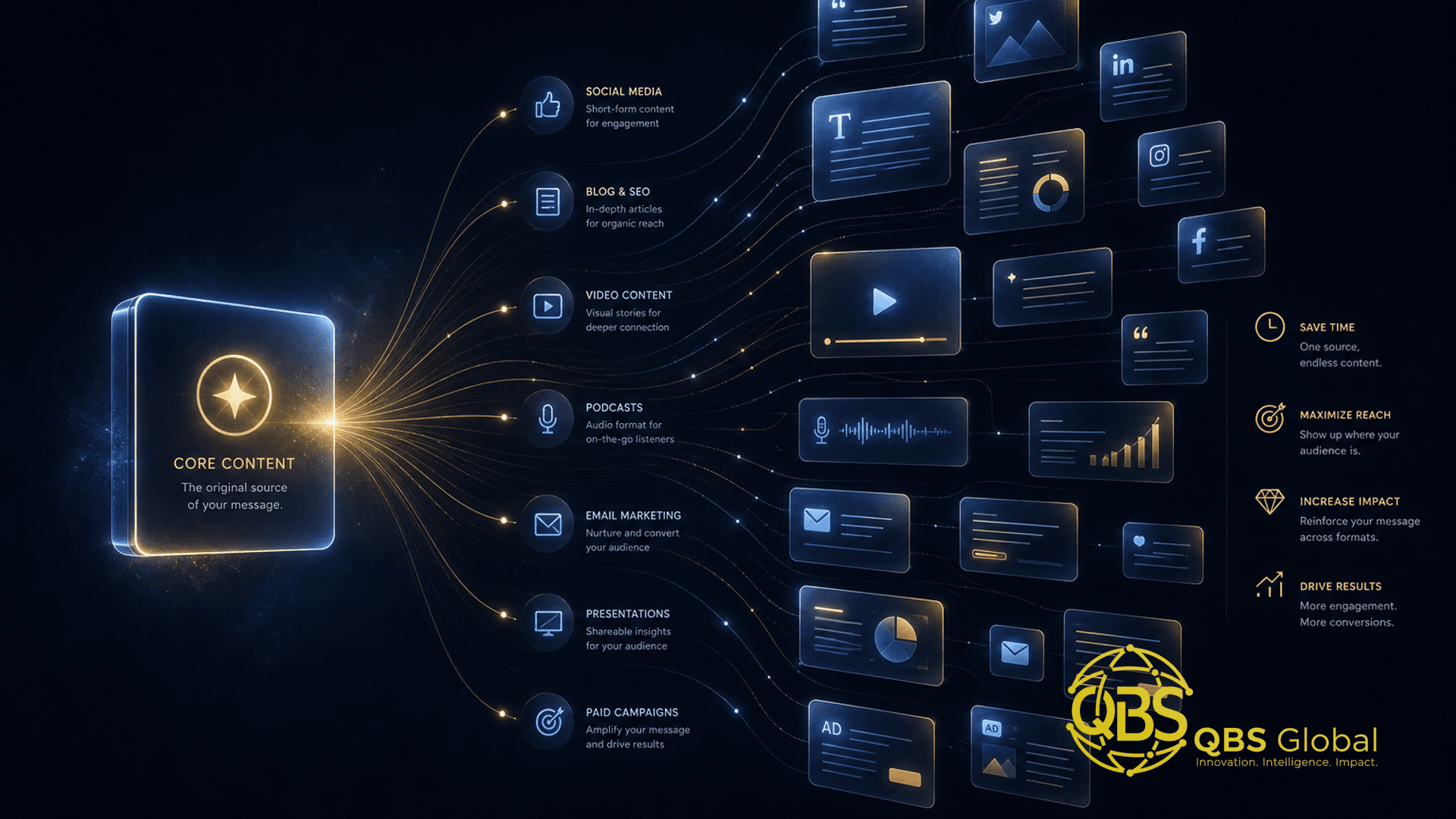
Everything else — the editing, the scheduling, the graphics, the tedious repurposing of a single walkthrough into a reel, three stories, a carousel, and a LinkedIn post — is exactly the kind of busywork an external team should absorb. The same logic applies whether you're an agent or any other service firm: this is the heart of a content repurposing system for service businesses, where one piece of raw footage becomes a week of content without you touching an editing timeline.
Keeping your authentic voice when someone else posts
The fear is reasonable: hand social to someone else and it starts sounding like a brochure. It happens — but only when agents delegate the production without supplying the raw material. The output sounds generic because the input was generic.
The fix is to separate voice from labor. Your voice — your phrasing, your market opinions, your face on camera — is the one thing that can't be outsourced. The labor of turning that voice into polished, scheduled posts absolutely can. The trick is feeding the team enough of the real you that they're transcribing, not inventing.
Three habits make this work:
- Record raw, let them polish. Walk a listing with your phone and talk like you'd talk to a client. Drop a 60-second voice note with your read on the local market. The team edits, captions, and formats — they don't fabricate opinions you never had.
- Build a one-page voice guide. Five phrases you actually use, three you'd never say, your stance on hype, your typical sign-off. This single document is what separates content that sounds like you from content that sounds like a template.
- Approve in your words, not theirs. When a draft comes back slightly off, don't just thumbs-up. Rewrite the one line that matters in your own phrasing. Within a month the team internalizes the pattern and the edits shrink to near zero.
The principle: outsource the hands, never the voice. Done right, the audience can't tell — because every opinion, every on-camera moment, and every market call genuinely came from you. The team just made it consistent and watchable.
The content cadence and approval workflow that works
Consistency beats brilliance on social, and consistency is a workflow problem, not a willpower problem. The setup below keeps you in control without putting you back in the editing chair.
A workable weekly rhythm for a solo agent looks like this:
- You batch raw input once a week (30–45 minutes). Record two or three phone walkthroughs or talking-head clips, plus a couple of voice notes on market news. That's your entire creative obligation for the week.
- The team produces ahead of schedule. They edit, write captions, design any graphics, and load a full week of posts into a scheduler — drafts ready 48 hours before anything goes live.
- You approve in one sitting (15 minutes). Review the batch, fix any line that's off, flag anything with a compliance question. Approve or send back.
- The team publishes and triages engagement. They post on schedule, handle first-pass comment replies, and escalate anything that looks like a real buyer straight to you.
The non-negotiable is the same-day approval gate: nothing that mentions a price, a listing fact, or a representation about your services publishes without your sign-off. That single checkpoint is what makes delegation safe in a licensed profession — the team owns production speed, you own the final word on anything that's a claim.
Cadence target: pick a number you can sustain forever, not a number that impresses you this week. Twice a week, every week, beats daily for a fortnight and then silence. The whole reason to outsource is to make "forever" actually achievable.
What outsourced real estate social media costs
Pricing varies more by who you hire than by what you need. Here's the honest range.
| Option | Typical monthly cost | What you get |
|---|---|---|
| DIY (your time only) | "Free" + 5–8 hrs/week | Full control, inconsistent output, opportunity cost |
| Freelancer / VA | $300–$800 | Editing + scheduling, limited strategy |
| Offshore managed team | $400–$1,500 | Production + cadence + reporting at a lower rate |
| Domestic agency | $1,000–$3,000+ | Full service, higher overhead built into the price |
For context on the domestic end: U.S. social media agencies commonly charge $1,000 to $3,000 a month for organic content management alone, with paid-ad management billed separately. That's the going rate for the same core deliverables an offshore team produces — the difference is overhead, not output quality.
This is the core reason agents look offshore. A capable team in a lower-cost market delivers the same editing, captions, scheduling, and reporting at a fraction of domestic agency rates. The deliverable list is identical; the cost base behind it isn't. We unpack this trade-off in depth in our guide to outsourcing social media to an offshore team, including how to judge quality when the team isn't in your time zone.
Watch the real number: cost per consistent week, not cost per month. A $1,500 domestic retainer that produces three posts a week is more expensive per result than a $600 offshore engagement that reliably ships eight. Judge by sustained output, not the sticker.
How to brief and onboard an offshore social team
A bad offshore experience is almost always an onboarding failure, not a talent failure. The team can only be as good as the brief you hand them. Spend a focused half-day up front and the next year runs itself.
Your onboarding pack should include:
- Account access, scoped properly. Use a social-media-manager role or a tool like Meta Business Suite or a scheduler that grants posting rights without your password. Never hand over raw logins.
- The one-page voice guide. Phrases you use, phrases you don't, your market stance, your sign-off. This is the highest-leverage document you'll write.
- A do-not-say list. The compliance guardrails: no price claims without written confirmation from you, no fair-housing-sensitive phrasing, no representations about a listing that you haven't approved. Make it explicit and short.
- Five reference posts. Three of your own that worked, two from agents whose style you admire. Show, don't just tell.
- The weekly rhythm in writing. When you'll send raw input, when drafts are due, when you approve, when they publish. Ambiguity here is what creates missed weeks.
On the working relationship itself: agree on time-zone overlap and a single channel for approvals. A couple of overlapping hours a day and one shared thread for sign-offs removes 90% of the friction people blame on "offshore being hard." The same playbook applies to any function you hand off — the principles in our broader guide to building an offshore team that runs without you carry directly into social.
One more guardrail worth stating plainly: the failures that sink local social efforts — posting with no funnel, chasing vanity metrics, treating the feed as a noticeboard — don't disappear just because you've outsourced. We catalog the most common of these in social media mistakes SMEs keep making, and a good offshore team should be actively steering you away from every one of them.
DIY 30-day system vs full outsourcing: choosing
Outsourcing isn't the only path, and it isn't always the right first move. If you've never run a consistent feed, you may not yet know your own voice well enough to brief anyone — and you'll struggle to judge whether outsourced output is good.
Here's the honest decision framework:
| If this is you… | Start here |
|---|---|
| Never posted consistently; unsure of your voice | DIY a structured 30-day run first |
| Posting works, but eats time you can't spare | Outsource production, keep the camera |
| Scaling listings, need volume across platforms | Full offshore team + your weekly input |
| Tight budget, comfortable on camera | Freelancer for editing, you handle the rest |
The strongest sequence for most agents is DIY first, then delegate. Run a disciplined month yourself to discover what your audience responds to and what you sound like at your best. Then hand that proven pattern to a team to scale. Our 30-day social media system for real estate agents is built exactly for that first phase — a structured month that produces both content and the self-knowledge you need to brief an outsourcing partner well.
The trap to avoid is the false binary. It's not "do it all myself" versus "outsource everything." The winning model is hybrid: you stay the voice, the face, and the final approver — the team becomes the engine that makes consistency effortless. You're not handing off your social presence. You're handing off the busywork that was stopping you from having one.
If you'd like a tailored roadmap for which parts to keep, which to delegate, and what cadence is realistic for your market, book a free 30-minute call with QBS Global and we'll map it out with you — usually within 48 hours of you reaching out.
Frequently asked questions
Should real estate agents outsource their social media?+
Most should outsource the production work — editing, scheduling, captions, graphics — while keeping the relationship-driven parts in-house. Agents who try to do everything themselves usually post inconsistently, and inconsistency is what kills reach. Outsourcing the busywork is what makes a steady cadence possible without eating your selling hours.
How much does it cost to outsource social media for a real estate agent?+
A solo agent working with an offshore team or specialist typically pays somewhere between $400 and $1,500 a month for managed organic content, well below the $1,000 to $3,000 a month many domestic agencies charge for organic management alone. The exact figure depends on platform count, video volume, and whether community management is included.
Will outsourced content still sound like me?+
Yes, if you build a voice guide and supply raw material. The agent records phone-video walkthroughs and quick voice notes; the team turns that into polished posts in your words. The team should never invent market opinions, quote prices, or make claims on your behalf — those always come from you.
What social media tasks can a real estate agent NOT delegate?+
You cannot delegate being on camera, your genuine market take, replying to a hot buyer in your DMs, or anything that legally binds you (listing claims, fair-housing-sensitive language, price commitments). Those stay with the licensed agent. Everything around them — editing, posting, repurposing, reporting — can be handed off.
How do I keep my offshore social media team compliant with real estate advertising rules?+
Give them a do-not-say list, require that every listing claim and price comes from you in writing, and keep a same-day approval step before anything publishes. The team handles production; you remain the licensed reviewer of anything that makes a representation about a property or your services.
How long before outsourced social media produces leads?+
Treat the first 60 to 90 days as consistency-building, not lead-counting. Reach and saves usually move first, DMs and profile visits next, and booked calls last. If you are switching from sporadic posting to a steady cadence, the compounding effect typically shows up in the second and third months.