Managing an Offshore Team Across Time Zones: The Overlap-Window + Async Handoff System
How to manage an offshore team across time zones with a protected overlap window and an async handoff system that prevents context loss and lost days.
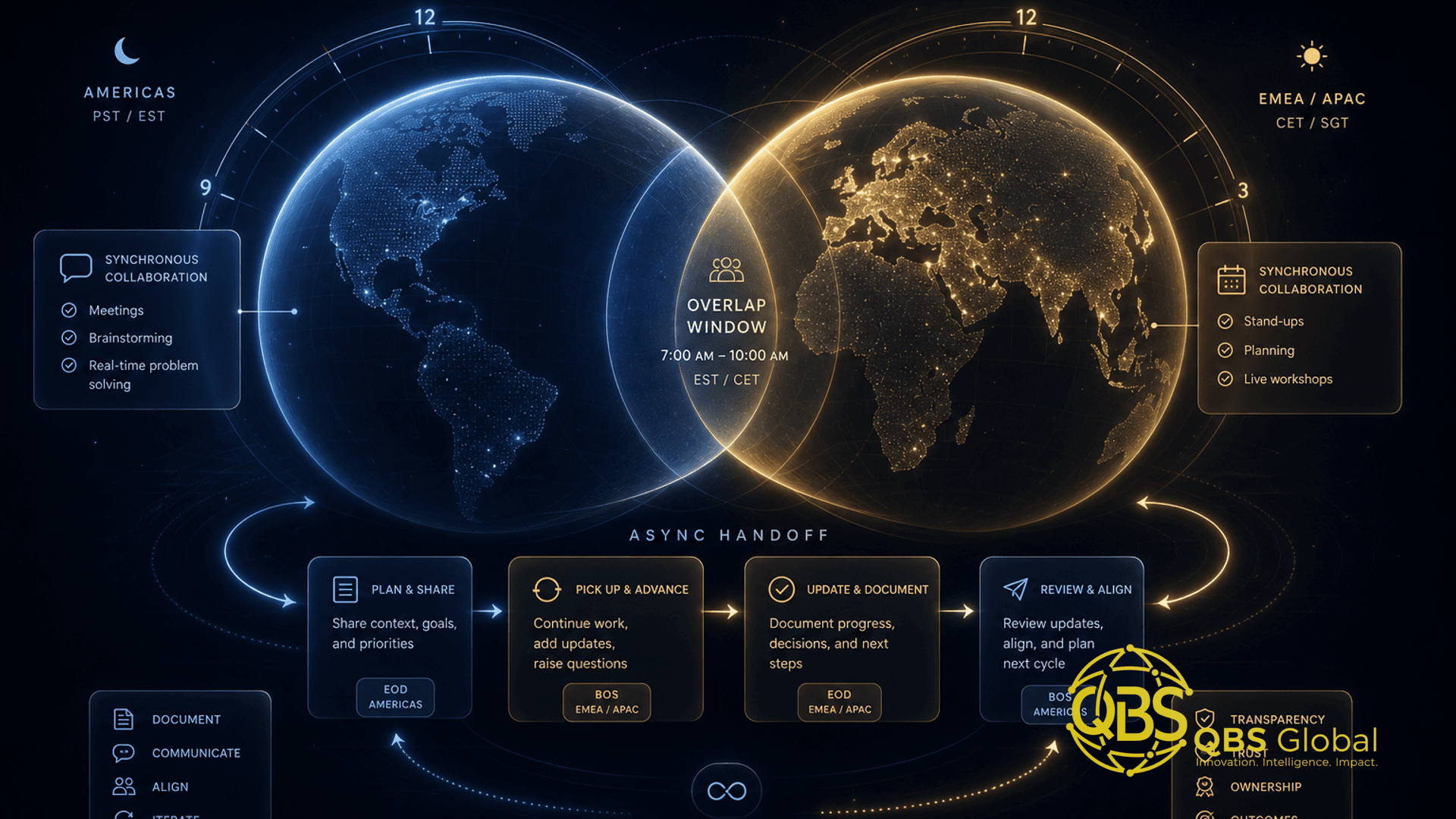
You hired an offshore team to move faster and free up your week. Instead you are answering Slack at 11pm, decisions that should take ten minutes take two days, and every Monday someone has built the wrong thing because a detail got lost in the handoff. The time zone gap that was supposed to give you "around-the-clock progress" is mostly giving you delay and rework.
This is a systems problem, not a people problem. The fix is not more meetings, more check-ins, or a "just go async" pep talk. It is a specific, repeatable structure: one small protected overlap window for the things that genuinely need real-time, plus a disciplined async handoff for everything else. This guide gives you that system end to end — what goes where, the exact handoff template, the documentation stack that prevents context loss, and a meeting rhythm that survives a 9-to-12-hour gap.
Why 'just go async' advice fails real teams
"Async-first" is good advice that gets misread as "async-only," and async-only is where distributed teams quietly fall apart. The appeal is real: in Buffer's 2023 State of Remote Work report, only 15% of remote workers cited collaboration and communication as a struggle — down year over year — because written, async work genuinely solves a lot. And survey data compiled across the industry suggests around 42% of workers now see asynchronous communication as the future of work, with a majority believing most of their meetings could have been an email or a recorded video.
But go fully async and three things break.
Decisions stall. When nobody is online at the same time, an ambiguous question — "should this be one screen or two?" — turns into a 24-hour round trip. Multiply that across a sprint and your "faster" team is slower than a co-located one.
Trust erodes. Text strips tone. A terse async comment reads as cold; a delayed reply reads as disinterest. Without any live contact, small frictions never get repaired and the relationship calcifies into transactional ticket-passing.
The human cost stays hidden. Time zones remain a genuine pain point — 19% of remote workers in Buffer's 2023 report named working across time zones as a struggle, and 23% named loneliness. Pure async, with no shared moment in the day, makes both worse.
The teams that win do not pick async or sync. They run async by default, with one small synchronous window that is treated as sacred. Everything below is how to build that.
If you are still deciding how to structure the team itself — in-house, nearshore, or fully offshore — start with how to build an offshore development team in 2026, then come back here for the operating rhythm.
Designing your 2-3 hour overlap window (and protecting it)
The overlap window is the few hours each day when both locations are online at the same time. Get this one design decision right and most other problems shrink.
Aim for two to three hours of genuine overlap. Less than two hours and there is not enough time to unblock people and make decisions in the same day. More than three and you have effectively rebuilt a co-located schedule — which means one side is working antisocial hours every single day, and you are paying for it in attrition whether you see it on the invoice or not.
Here is the reality for common pairings:
| Your location | Offshore location | Approx. gap | Natural overlap |
|---|---|---|---|
| US East Coast | South Asia | 9.5–10.5 hrs | Your early morning / their evening |
| US East Coast | Latin America | 1–3 hrs | Easy, most of the day overlaps |
| UK | South Asia | 4.5–5.5 hrs | Your morning / their afternoon |
| UK | Philippines | 7–8 hrs | Your early morning / their afternoon |
| Western Europe | South Asia | 3.5–4.5 hrs | Comfortable midday overlap |
For wide gaps like US-to-South-Asia, the only humane overlap is your morning against their evening. The fairest move is to split the discomfort: you start your day an hour early, they end theirs an hour late, and you rotate who carries the heavier edge. (This is exactly why some teams choose a nearshore dev team in Latin America from the US — a one-to-three-hour gap makes overlap nearly free.)
Protecting the window matters more than choosing it. A window that gets eaten by ad-hoc calls and "quick syncs" stops being reliable, and the whole system depends on it being reliable. Three rules:
- Block it on every calendar, both sides, recurring. It is not negotiable meeting space.
- No solo deep work scheduled inside it. The window is for the things that need both people. Heads-down work happens on either side of it.
- Default to keeping it even when there's "nothing to discuss." A 15-minute live touch beats a silent day, and the standing slot is what makes async handoffs trustworthy.
What belongs in overlap vs what belongs in async
The single highest-leverage habit you can install is a shared, explicit rule for what gets a live conversation and what gets written down. Without the rule, everything drifts toward "let's just hop on a call," and your overlap window — and your evenings — get swallowed.
The test is simple: does this need back-and-forth, or does it need a paper trail?
| Put it in the OVERLAP window | Put it in ASYNC |
|---|---|
| Ambiguous decisions with real trade-offs | Status updates and progress reports |
| Unblocking someone who is genuinely stuck | Code review and PR feedback |
| Conflict, tension, or anything emotional | Specs, requirements, and acceptance criteria |
| Relationship and trust building | FYIs, announcements, and "heads up" notes |
| Kicking off something brand-new and fuzzy | Anything with a clear, single right answer |
| Demos that need live reaction | Recorded walkthroughs of finished work |
A useful heuristic for the gray cases: if a message does not need a reply within the hour, it is async. Status does not. A blocked engineer at the start of their day does. Treat the overlap window as expensive real estate — because it is — and only the things that truly need real-time earn a spot.
This discipline is the same whether you are running developers, a managed offshore project management function, or a single offshore assistant. The categories do not change; only the volume does.
The async handoff/handover template
The handoff is the heartbeat of an offshore team. It is a short written summary one side leaves at the end of their working day so the other side can start immediately — no waiting for a call, no guessing what changed. Done well, it turns the time-zone gap from a 12-hour delay into a genuine relay where work never fully stops.
Keep it short and structured. A handoff people actually read beats a perfect one nobody finishes. Post it in the same place every day — a dedicated channel or doc thread — at the same time.
The end-of-day handoff template:
HANDOFF — [Name] — [Date]

DONE TODAY
- [What I finished, with links to the PR / doc / ticket]

IN PROGRESS
- [What I'm mid-way through, and where exactly I left it]

BLOCKED / NEED FROM YOU
- [The specific decision or input I need before I can move]
- [Frame it as a clear question with options, not "let's discuss"]

NEXT UP (if I get to it / for whoever picks this up)
- [The next 1-2 things in priority order]

WATCH OUT FOR
- [Any landmine: a flaky test, a fragile dependency, a client nuance]
The two sections that do the heavy lifting are BLOCKED / NEED FROM YOU and WATCH OUT FOR. The blocked section is what lets the other side resolve your blocker during their day so the answer is waiting when you wake up — that is the whole around-the-clock dream, made real. The watch-out section is cheap insurance against the silent rework that eats offshore teams alive.
The rule that makes it work: every blocker is phrased as a decision, not a discussion. "Should the export be CSV or Excel? I recommend CSV because the client's tools ingest it directly — flag if you disagree" can be answered in five seconds across a time zone. "Let's talk about the export format" cannot, and it costs you a full day.
Your documentation stack for zero-context-loss
Async handoffs only work if there is a stable place to point at. If the spec lives in someone's memory, in a DM, or in a call that was never recorded, the gap will find it and break it. This is the lesson the most extreme distributed companies learned the hard way.
GitLab, one of the largest all-remote, async-first companies in the world, runs on a public handbook of thousands of pages as its single source of truth — their rule is "if it isn't written down, it didn't happen." You do not need a 2,000-page handbook. You need the same principle applied at your scale: the answer to "where is the truth on this?" should never be a person.
A workable documentation stack has four layers:
| Layer | What lives here | Why it matters across time zones |
|---|---|---|
| Source of truth | Specs, decisions, processes, "how we do X" | The thing both sides point to instead of asking each other |
| Task tracker | Who owns what, status, acceptance criteria | Async status without a single "any update?" message |
| Decision log | What we decided, when, and why | Stops the "why is this like this?" loop 6 months later |
| Handoff thread | The daily end-of-day handoffs | The running relay baton between zones |
Two practices matter more than the tools you pick:
- Write decisions with their reasoning. "We chose Postgres over Mongo because our data is relational and we need joins" prevents the offshore side from quietly relitigating it — or worse, building against the wrong assumption.
- Make recorded video a first-class document. A three-minute screen recording walking through a tricky flow carries tone and context that text cannot, and the other side watches it on their schedule. It is the closest thing to looking over someone's shoulder across a 10-hour gap.
The payoff compounds. Every documented decision is a question that never has to wait a full day for an answer.
Meeting rhythm: standups, demos, and 1:1s that survive the gap
You still need ceremony — just less of it, and most of it written. Here is a rhythm that holds up across a wide time-zone gap.
Daily standup → mostly async. Replace the live standup with a written one posted in a channel before the overlap window: what I did, what I'm doing, what's blocking me. It is essentially the handoff template, lighter. Reserve the live overlap window for the blockers that actually surfaced, not for everyone reciting their day to an audience. Status reporting is the single most common thing teams keep doing live that they should not — meeting-research summaries consistently flag status updates as the meeting type most often judged unnecessary.
Weekly demo → live, inside the window. Once a week, show finished work live. Demos are high-bandwidth and emotional — people want to see reactions and ask questions in the moment. This is exactly what the overlap window is for. If a key person genuinely cannot attend, record it; do not cancel it.
1:1s → live, and non-negotiable. This is the one meeting you never move to async. The 23% loneliness figure from Buffer is real, and the only fix is human contact. A 25-minute live 1:1 every week or two — camera on, no agenda required — is what keeps an offshore teammate a teammate and not a ticket-resolution endpoint. It is also where you catch the frustration that would otherwise show up three weeks later as a resignation.
A sane weekly cadence:
| Cadence | Format | Where |
|---|---|---|
| Daily | Written standup + handoff | Async |
| Daily | Unblock + decisions | Live overlap window |
| Weekly | Demo of finished work | Live overlap window |
| Weekly / biweekly | 1:1 per person | Live overlap window |
| Monthly | Retro: what's working in our system | Live overlap window |
Notice how little is live. The overlap window carries unblocking, demos, 1:1s, and a monthly retro — and that is all. Everything else is written. That is the ratio you are aiming for.
Tooling and a downloadable handoff checklist
The tools matter far less than the discipline, but you do need one of each layer. Stay vendor-neutral and pick what your team already knows:
- Source of truth: a docs base (Notion, Confluence, a Git wiki, or even well-organized Google Docs).
- Task tracker: whatever you already run (Linear, Jira, Trello, GitHub Projects).
- Async chat: Slack or Teams — with a hard norm that no reply is expected outside the overlap window.
- Async video: any screen recorder (Loom-style tools, or just your meeting app's record button) for walkthroughs and demos.
- The glue: if handoffs and standups are getting skipped, a lightweight automation in a tool like Zapier or n8n can prompt for them at end-of-day and route blockers into your tracker — so the system runs even on the days people are tired.
Your offshore-team operating checklist — steal this:
OVERLAP WINDOW
[ ] 2-3 hrs of real overlap chosen, discomfort split fairly
[ ] Blocked on both calendars, recurring, protected
[ ] No solo deep work scheduled inside it

WHAT GOES WHERE
[ ] Written rule for live-vs-async, visible to everyone
[ ] Status / specs / FYIs / code review → always async
[ ] Decisions / unblocking / conflict / demos → live window

HANDOFF
[ ] End-of-day handoff posted same place, same time
[ ] Every blocker phrased as a decision with options
[ ] WATCH-OUT section never skipped

DOCUMENTATION
[ ] Single source of truth — answer is never "ask a person"
[ ] Decisions logged WITH their reasoning
[ ] Tricky flows recorded as short video

MEETING RHYTHM
[ ] Standup async, blockers live
[ ] Weekly demo live (recorded if someone's out)
[ ] 1:1s live and never cancelled
This system scales down as well as up. Whether you are coordinating a full offshore dev pod, an outsourced project management function, or a single virtual assistant in the Philippines managed from the UK, the moving parts are identical: protect a small overlap, write everything else down, and make the handoff sacred.
The reason most offshore arrangements underperform is not the talent or the distance — it is the absence of this operating layer. Put it in place and the time-zone gap stops being a tax and starts being the around-the-clock advantage you hired for.
If you are setting up a distributed team and want this system tailored to your exact time-zone spread, tooling, and delivery model, book a free 30-minute call with QBS Global and we will map a concrete operating rhythm and handoff workflow for your team within 48 hours — including where automating the busywork can keep it running on its own.
Frequently asked questions
How do you manage an offshore team across time zones without burning out?+
Design one protected overlap window of two to three hours where both sides are online, use it only for decisions and unblocking, and push everything else to a written async handoff. The mistake that burns people out is forcing real-time meetings outside that window — fix the system, not the people.
How big should the overlap window between time zones be?+
Two to three hours of shared working time is enough for most teams. Less than two hours and decisions queue up for a full day; more than three and you have effectively recreated a co-located schedule that quietly forces one side to work antisocial hours. Two to three hours, fiercely protected, is the sweet spot.
What belongs in a live meeting versus async when teams are in different time zones?+
Live overlap is for things that need back-and-forth: ambiguous decisions, conflict, unblocking a stuck person, and relationship-building. Async is for everything with a clear answer or a paper trail — status updates, code review, specs, FYIs, and progress reports. If a message does not need a reply within the hour, it should be async.
What is an async handoff and why does it matter for offshore teams?+
An async handoff is a short written summary one side leaves at the end of their day so the other side can start working immediately without waiting for a live call. It matters because it converts the time-zone gap from a delay into an advantage — work continues around the clock instead of stalling for 12 hours every handoff.
What tools do I need to run a distributed team across time zones?+
You need four layers, not more: a single source-of-truth doc base, a task tracker, async chat, and async video for anything that needs tone or a demo. The specific brands matter far less than the discipline of writing things down. A team with rigorous documentation on cheap tools beats a team with expensive tools and no written record.
Should I just make my whole offshore team work asynchronously?+
No. Pure async with zero overlap quietly kills speed and trust — decisions take days and small misunderstandings fester for a full cycle. The system that works is async by default plus one small, protected synchronous window. You need both, with clear rules for what goes where.