Social Search Optimization: How Service Firms Get Found When People Search on TikTok and Instagram
A practical guide to social search optimization for service business: how platform search ranking works and how to get found on TikTok and Instagram.
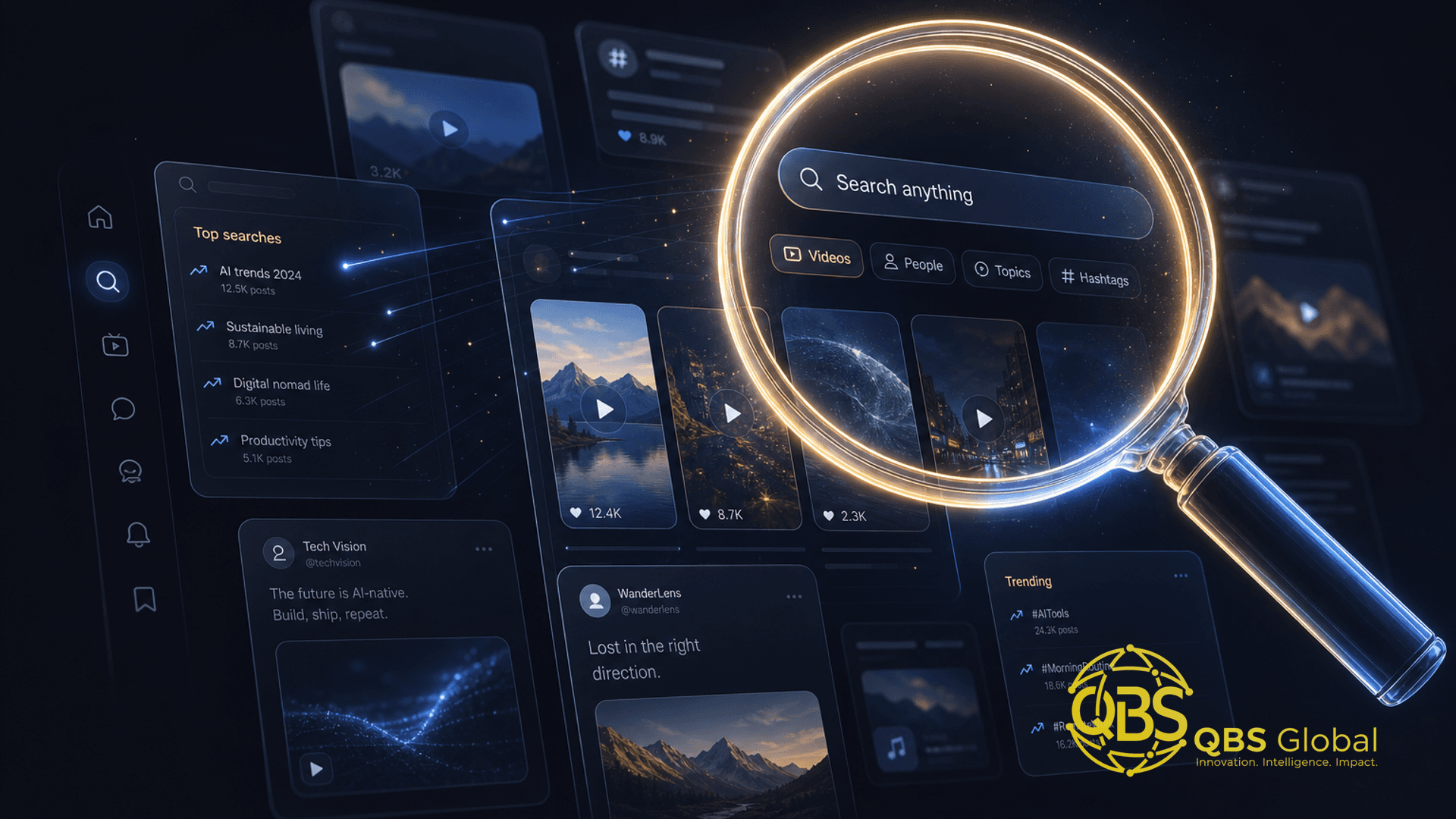
Type a question into TikTok and you will get answers — restaurant picks, how-to walkthroughs, honest reviews, "is this service worth it." A large share of younger buyers now start there instead of opening Google. Google's own search chief said the quiet part out loud: in their studies, almost 40% of young people looking for a place for lunch go to TikTok or Instagram, not Google Maps or Search. That single admission turned a fringe behavior into a strategy that marketers now call social SEO — and in 2026 it is its own discipline.
This article is the operator's version. Not "social search is the future" hand-waving, but how platform search actually ranks content, how to do keyword research that fits these apps, and a repeatable workflow a service business can run without a content studio. It is vendor-neutral and built for firms that sell expertise — agencies, consultants, recruiters, accountants, software shops — not for lifestyle brands chasing virality.
Why people now search on TikTok and Instagram, not just Google
The shift is real and measured, not a vibe. Survey data shows 49% of U.S. consumers have used TikTok to search for something, and among Gen Z the habit runs deeper — roughly 64% of Gen Z and 49% of Millennials report using TikTok as a search engine. Instagram is in the mix too: in one survey, 67% of Gen Z said they use Instagram to search and 62% use TikTok, with Google trailing.
Why the behavior changed comes down to three things buyers actually want.
- They want a person, not ten blue links. A 40-second clip of someone explaining how a service works carries more trust than a text page optimized for a robot.
- They want to see the thing. "Show me what good client onboarding looks like" is a visual question. Social answers it natively.
- They want fewer ads dressed as results. A video that genuinely answers their question feels less like being sold to than a sponsored Google block.
The trend is settling, not exploding without limit — Gen Z's preference for TikTok over Google has actually cooled from its peak, and an Adobe study found only about 10% of Gen Z users now prefer TikTok over Google outright. The honest read: social search is not replacing Google, it is a second front you cannot ignore. A service firm that only optimizes for one is invisible in the other.
The takeaway: social search is a permanent second search box for your buyers. If your expertise does not show up when someone queries it inside the app, a competitor's does.
This is also where a lot of small firms quietly lose ground — they treat social as a billboard for reach instead of an answer engine for intent. We unpacked that exact failure mode in the most common social media mistakes service SMEs make.
How platform search ranking actually works (audio, captions, transcripts)
Here is the part most "post more reels" advice skips: these platforms read your video. They do not just match your typed caption — they transcribe what you say, scan the text on screen, and parse your description, then index all of it. That is why social search is winnable for a small firm. You are optimizing text the platform extracts, the same way Google reads a page.
The signals a platform uses to decide if your post answers a search query:
| Signal | What it is | How much you control it |
|---|---|---|
| Spoken audio (transcript) | The platform auto-transcribes what you say in the video | High — script the first lines |
| On-screen text / captions | Words you burn onto the video or auto-captions | High — write them deliberately |
| Written description | The caption field below the post | High — front-load the query phrase |
| Hashtags | Topical tags you attach | Medium — a few precise ones beat many vague ones |
| Alt text / accessibility text | Descriptive text some platforms let you set | Medium — underused, worth filling |
| Early engagement | Saves, shares, watch-through, comments in the first hours | Low/indirect — earned by relevance |
The practical consequence is blunt: if you never say or write the words your buyer would type, the platform has nothing to match. A beautiful, silent, caption-free video is invisible to search no matter how good it looks. The firms winning social search treat the spoken first sentence and the on-screen text as ranking real estate, not afterthoughts.
There is a quieter point underneath this. Social platforms are increasingly where AI answer engines and recommendation systems pull from too. Optimizing your spoken and written text for human search overlaps heavily with optimizing for machines that summarize and recommend — the same discipline we cover in generative engine optimization for service businesses. Clear, query-shaped language serves both.
Keyword research for social search (it's not Google keywords)
Stop reaching for your Google keyword tool. Social search queries are spoken-language, problem-first, and often longer. People do not type "B2B onboarding software." They type "why does client onboarding take so long" or "how to onboard clients without spreadsheets." The intent is the same; the phrasing is human.
A free, five-step research method that uses the platforms themselves as the tool:
- Use the search bar's autocomplete. Open TikTok or Instagram, type a seed phrase tied to your service ("hire a developer," "outsource bookkeeping"), and watch what the app suggests. Those suggestions are real queries people run.
- Read the "others searched for" row. After you search a term, both apps show related searches under the results or above the video. That is a free map of adjacent intent.
- Mine your own comments. The questions people leave on your posts — and on competitors' — are exact-match search queries waiting to be answered.
- Watch the on-screen text of ranking videos. Search your topic, see which videos surface, and note the phrases they put on screen. The platform rewarded those words for a reason.
- Group by intent, not volume. Sort queries into "what is," "how to," "is X worth it," "X vs Y," and "best X for Y" buckets. Each bucket is a content series.
Pick conversational, intent-led phrases over broad head terms. "Social media management" is a wall of established creators. "How much should social media management cost a small business" is a specific buyer question almost nobody is answering well on video — and the person asking it is closer to hiring.
The takeaway: the best social search keyword is a sentence your buyer would actually say out loud at the moment they have the problem. Build one post per sentence.
On-video and on-caption optimization for a service business
This is where research becomes ranking. The goal is to put your target phrase in front of the platform's reading systems at least three times — spoken, on screen, and in the description — without sounding like a robot.
A field checklist for a single search-optimized post:
- Say the query in the first 3 seconds. Open with the question itself: "How do you onboard a new client without drowning in email?" The transcript now contains your keyword, and the viewer knows the video is for them.
- Burn the keyword onto the screen. Put the phrase as on-screen text in the opening frame. This feeds the visual-text signal and survives muted autoplay.
- Front-load the written caption. First line of the description = the search phrase, in plain language. Save hashtags and links for the end.
- Answer fast, then expand. Give a usable answer within the first 15 seconds so watch-through (a ranking input) stays high. Depth comes after you have earned attention.
- Use 3–5 precise hashtags, not 20. One broad, one niche, one intent-led. A pile of generic tags dilutes relevance.
- Fill alt/accessibility text where the platform allows it. It is extra indexable text most competitors leave blank.
- End with a soft, specific next step. "Comment 'onboarding' and I'll share the checklist" drives the engagement that compounds search ranking — and starts a real conversation.
Match the format to the query type. A "how to" deserves a screen-recorded walkthrough. An "is X worth it" deserves a talking-head with an honest take. A "X vs Y" deserves a simple side-by-side. The format is part of the answer, and the platform notices when viewers stay because the format fits.
The reason this scales for a service business is that you already own the raw material — you answer these exact questions on sales calls every week. The job is repurposing, not invention. A single well-researched blog post or recorded call can seed a dozen search-optimized clips, which is the whole premise of a content repurposing system built for service firms. Research once, rank in many places.
Local and B2B discovery: getting found by intent, not just reach
Reach is a vanity trap for service firms. You do not need a million views; you need the forty people this quarter who are actively searching for what you sell. Social search is unusually good at delivering exactly those people, because it ranks on intent.
For local and location-tied services, the levers are concrete:
- Name the place out loud and on screen. "Best property manager in [city]" needs the city in the transcript, the on-screen text, and the caption — same three-touch rule, plus the platform's location tag.
- Answer hyper-local queries others ignore. "Do I need a permit for X in [city]" is low-competition, high-intent, and positions you as the local authority.
For B2B service firms, the intent is buried in problem language, not industry jargon:
- Target the symptom, not your service name. Your buyer searches "our software project is months late," not "software project rescue consulting." Answer the symptom.
- Speak to the decision moment. "Should we hire in-house or outsource this" is a query a buyer runs right before they pick a vendor. Be the calm, honest voice in that result.
- Make trust the content. A short clip explaining how you'd approach their exact problem does more than a polished brand reel, because it answers the real underlying question: "can these people actually do this?"
The takeaway: intent-led discovery means a fifty-follower account can out-convert a fifty-thousand-follower one — if it answers the precise question a buyer types at the moment they are ready to spend.
Measuring social-search visibility
Likes lie. A post can collect hearts and drive zero business, while a quieter post answering a buyer question pulls in the lead that pays for the quarter. Measure search performance with signals that map to intent, not applause.
| Metric | What it tells you | Why it matters for search |
|---|---|---|
| Share of views from search / discovery | How much traffic comes from queries vs followers | The core proof social search is working |
| Saves and shares | Whether people found the post useful enough to keep | Strong intent signal, and a ranking input |
| Watch-through / completion | Whether your fast answer held attention | Drives whether the platform keeps surfacing it |
| Profile visits after a post | Whether a searcher wanted more from you | The bridge from discovery to consideration |
| Link clicks / "comment X" actions | Direct movement toward a conversation | The closest thing to a conversion on-platform |
| Longevity (views weeks later) | Whether the post keeps earning search traffic | Search-optimized posts compound; feed posts decay |
The single most useful habit: keep a simple sheet listing each post, the one query it targets, and whether it is still pulling views a month out. Posts that keep surfacing are your search winners — make more like them. Posts that died on day two were feed content, not search content. That distinction, tracked over a few weeks, tells you more than any dashboard.
Most platforms expose a search or discovery breakdown inside their native analytics. You do not need a paid tool to start — you need the discipline to look past the like count at where the views actually came from.
A repeatable posting workflow built for search, not just the feed
The reason most service firms fail at this is not talent. It is that they treat each post as a one-off creative act, burn out in three weeks, and quit. Search rewards the opposite: a steady stream of intent-led answers. So the workflow has to be boring enough to actually repeat.
A weekly loop a solo founder or a lean team can run:
- Harvest (30 min, weekly). Pull 5–10 real buyer questions from sales calls, comments, autocomplete, and your inbox. These are your week's queries.
- Batch-script (45 min). For each question, write a one-line hook (the query, spoken), a three-bullet answer, and the on-screen text. No production yet — just the words that need to rank.
- Record in one sitting (60–90 min). Film all of them back-to-back. Same lighting, same setup, different question. Batching is what makes consistency survivable.
- Edit for search, not polish. Add captions, burn the keyword on screen, keep the first 15 seconds tight. Done beats beautiful.
- Publish with the three-touch rule. Spoken keyword, on-screen keyword, caption keyword — every single time.
- Review every two weeks. Check which queries are still pulling views. Double down on winners, retire formats that died.
Where automation helps and where it doesn't. Automate the mechanical glue — transcription, scheduling, resizing for each platform, drafting first-pass captions with a tool like ChatGPT, routing tasks through something like n8n or Zapier. Keep a human on the angle, the honest take, and any reply that speaks for the brand. The judgment is the product; the busywork is not.
This is exactly the kind of repeatable, judgment-light system that runs better with a dedicated pair of hands than with a founder squeezing it in at midnight. Many service firms reach a point where the smartest move is handing the whole posting engine to an offshore team and keeping only the strategy in-house — the work compounds when it actually happens every week instead of in guilty bursts.
There is real momentum behind building this muscle now. Small businesses are leaning in hard: 71% of small businesses planned to increase their TikTok marketing spend in 2024, up from 52% the year before. The early movers in your category are already answering your buyers' questions on video. The window to own those queries is open, but it narrows every quarter someone else fills it.
The takeaway: a dull workflow you run every week beats a brilliant one you abandon. Social search is a compounding asset — the firm that posts the boring, intent-led answer for fifty-two weeks straight wins the category search results.
Social search optimization is not a campaign you run once. It is a habit of turning the questions your buyers already ask into searchable answers, week after week, on the platforms where they now look first. If you'd like a tailored roadmap for your service line — which queries to target, what to post, and where automation fits — book a free 30-minute call with QBS Global and we'll map it with you within 48 hours.
Frequently asked questions
What is social search optimization for a service business?+
It is the practice of structuring your social posts — the spoken words, on-screen captions, written descriptions, and hashtags — so that platform search engines like TikTok and Instagram surface your content when someone types a relevant query. It treats each post as a searchable answer, not just a feed item that expires in a day.
How is social search different from regular SEO?+
Regular SEO ranks web pages in Google around backlinks, page speed, and indexed text. Social search ranks individual posts inside an app using signals the platform can read directly: your spoken audio, auto-generated captions, on-screen text, the written description, and early engagement. The keywords people use are more conversational, and the unit that ranks is a single video, not a whole site.
Do you need to say keywords out loud in a video?+
It helps. TikTok and Instagram transcribe spoken audio and use it as a ranking signal, so naming the problem and the query phrase in the first few seconds gives the platform clear text to match against. You should reinforce the same phrase in your on-screen caption and written description rather than relying on the spoken word alone.
Can a B2B or local service firm actually get found through social search?+
Yes, often more easily than a consumer brand, because intent-led queries are less crowded than broad lifestyle terms. A bookkeeper, recruiter, or agency that consistently answers specific buyer questions — by service, by city, by situation — can rank for those phrases even with a small following, since social search rewards relevance over raw reach.
How do you measure social search visibility?+
Look past likes to search-led signals: the share of views coming from search or the For You surface, impressions tied to specific search terms where the platform exposes them, saves and shares as intent markers, and profile visits or link clicks after a video. Tracking which query each post targets and whether it keeps earning views weeks later tells you if search is working.
How often should a service business post for social search to work?+
Consistency matters more than volume. A sustainable rhythm of a few intent-led posts per week, each built around one real buyer question, compounds over time because search-optimized posts keep surfacing long after publication. A repeatable workflow beats sporadic bursts of high-effort content that nobody can maintain.