Outsourced Project Management for Marketing Agencies: How to Run Client Delivery Offshore
Outsourced project management for marketing agencies: how an offshore PM runs client delivery, tracking, and reporting so your team stops drowning.
Your agency probably doesn't have a talent problem. The creative is good, the strategy is sound, the clients renewed. What's breaking is the part nobody put on the org chart: someone making sure ten clients' worth of deliverables move through your team in the right order, on the right dates, with the right approvals — every single week.
That's the capacity problem, and it's the quiet reason good agencies stall. This guide is an operator-grade walkthrough of how outsourced project management for marketing agencies actually works: what an offshore PM owns, how delivery tracking and client reporting run in practice, and how to start with one account without blowing up the work you already have.
Why agencies drown in client deadlines (the capacity problem)
The math is brutal once you say it out loud. Every client wants to feel like your only client. Each one comes with a content calendar, ad iterations, approval rounds, and a standing call. Stack five, eight, twelve of those, and the work stops being "doing the work" and becomes sequencing the work — and sequencing is a full-time job that usually lands on a founder or an account lead who already has one.
This isn't an agency quirk; it's how projects fail everywhere. Across organizations, around one in three projects do not meet their original goals, and roughly half experience scope creep, according to PMI's Pulse of the Profession. In an agency, scope creep has a name: the "quick favor" that wasn't quoted, the extra revision round, the deck that grew three sections. Nobody tracks it, so it eats margin invisibly.
Utilization is where the damage shows up on the P&L. Healthy agencies generally aim for an 80–85% billable utilization rate, with anything above 90% risking burnout and people working over their contracted hours. The trap: when there's no one owning capacity, your best people swing between fully overloaded and idle, while the average still looks fine. You feel overloaded and under-booked at the same time, and you can't see why.
The honest diagnosis: you don't need more producers yet. You need someone whose entire job is making the producers you have ship on time, across every account, without you in the middle of it.
What an outsourced/offshore PM actually owns
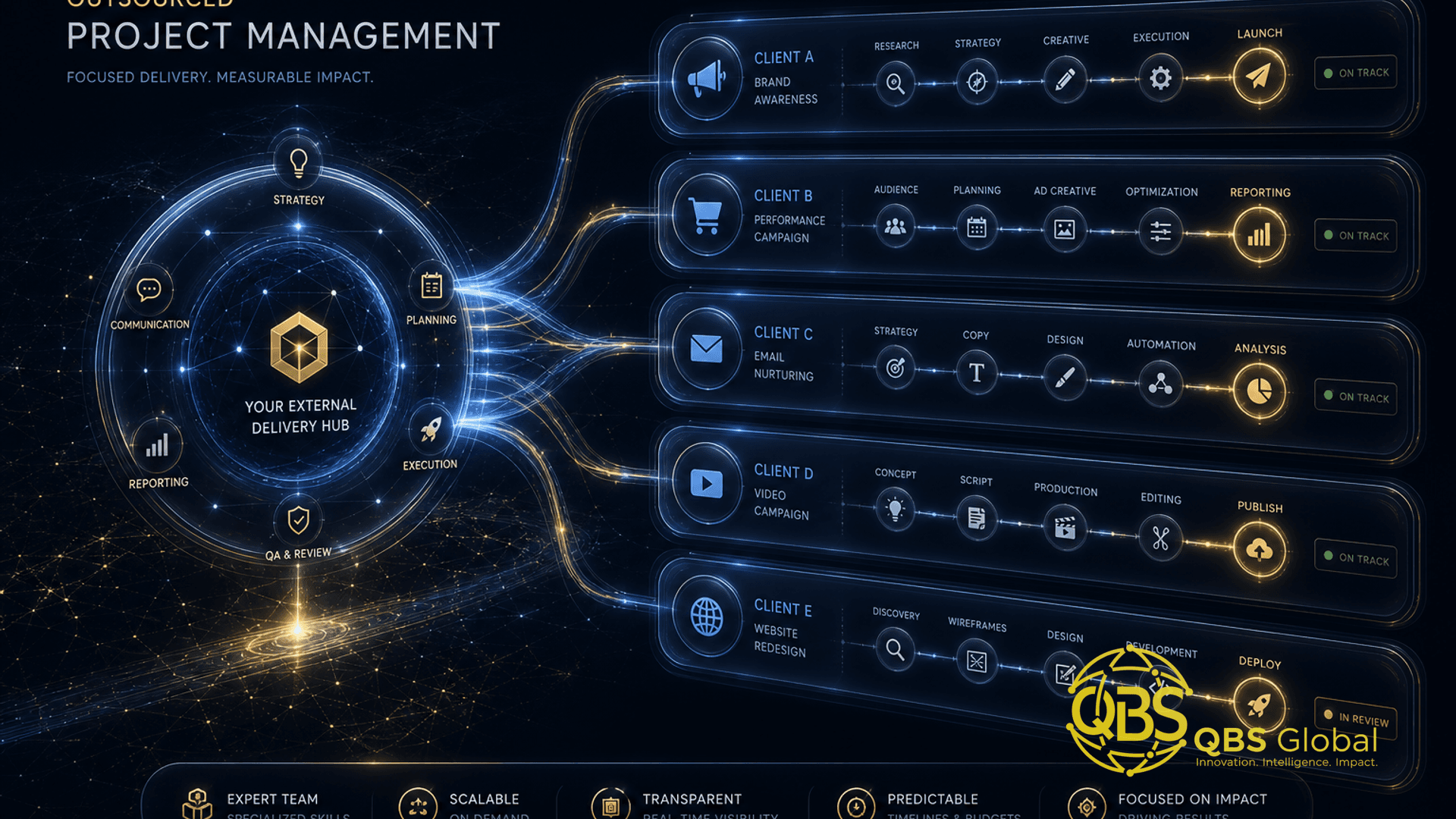
"Project management" gets used loosely, so let's be precise about what a real outsourced PM takes off your plate. They are not a coordinator who updates tickets. They own outcomes across your client roster.
Concretely, a good outsourced PM owns:
- The master delivery schedule — every client's deliverables, dependencies, and deadlines in one view, not scattered across briefs and inboxes.
- The approval chain — knowing what's waiting on the client, what's waiting on your designer, and who to chase today so nothing dies in someone's "to review" pile.
- Capacity allocation — who is working on what this week, and flagging the collision before two clients both want priority on Thursday.
- Status communication — the weekly client update and the internal standup, so account leads stop spending Friday writing recaps.
- Risk surfacing — telling you a deadline is going to slip while there's still time to fix it, instead of the morning it's due.
The offshore angle adds a structural advantage most agencies underrate: the clock keeps working when you don't. With a PM operating from a delivery hub like Pakistan or the Philippines, briefs handed off at the end of a US or UK day are organized, scheduled, and chased by the time you log on. The global outsourcing market is now worth over $850 billion and growing at roughly 5.5% a year precisely because this overnight-progress model works when it's run well.
For a fuller breakdown of what the role covers beyond agencies, our outsourced project management guide walks through the full scope and the models available.
Deliverable tracking and approval workflows across accounts
Tracking one client's work is easy. Tracking ten without dropping anything is the actual skill — and it's almost entirely about workflow design, not effort.
The foundation is a single source of truth for every deliverable across every account. One board, consistent stages, every client visible in the same system. The specific tool matters far less than the discipline — agencies run this well on Asana, ClickUp, Monday, Notion, or Trello. What breaks agencies is having delivery state live in three places: a spreadsheet, someone's head, and a Slack thread.
A workable cross-account stage model looks like this:
| Stage | What it means | Who's blocking |
|---|---|---|
| Briefed | Scope + deadline confirmed | Nobody — ready to start |
| In production | A producer is actively working | Internal team |
| Internal review | Done, awaiting agency QA | Account lead / PM |
| Client review | Sent, awaiting client sign-off | The client |
| Approved | Signed off, ready to ship | Nobody |
| Live | Published / delivered | Done |
The PM's daily job is reading that board and acting on the "who's blocking" column. Anything stuck in Client review for more than 48 hours gets a chase. Anything stuck in Internal review means QA is the bottleneck, not the client. That single habit — chasing by stage, every day, across all accounts — is what separates a board that reflects reality from a board that's a museum of good intentions.
Approval workflows deserve their own rule: every deliverable has one named approver and one deadline to approve by. Vague "the client will get to it" is how a week vanishes. The PM sets the expectation up front ("we need sign-off by Wednesday to hit your Friday launch") and follows up when it slips. This is unglamorous and it's the entire game.
Client portals and status reporting clients trust
Clients rarely churn because the work was bad. They churn because they felt out of the loop and assumed the worst. Reporting isn't admin — it's retention.
A client status report that actually builds trust is short, scannable, and the same shape every week:
- Shipped this week — concrete, with links.
- In progress — what's moving and when it lands.
- Waiting on you — the approvals or assets you need from the client, with dates.
- Heads-up — anything that might affect timeline, surfaced early.
That "waiting on you" section is the quiet superpower. It moves accountability into the open without a confrontation, and it's why a client can't credibly say "you never told us" — because it's in writing, every week, with a date.
A client portal — even a simple shared board or a clean recurring doc — beats status-by-email because the client can self-serve the answer to "where are we?" without pinging your account lead. That deflects the anxious mid-week check-in that eats an hour and signals panic. The portal becomes the relationship's memory, and the outsourced PM keeps it current so it's never stale when the client looks.
The deeper point: clients equate visible with handled. An agency that reports like clockwork feels more in control than one quietly doing better work in silence. The PM owning this consistently is worth more in renewals than most agencies realize.
Managing capacity across competing client timelines
Here's the conflict every multi-client agency lives with: two clients, both with real Thursday deadlines, one designer. Someone has to make the call — and if that someone is the designer, you've already lost, because they'll either context-switch into mush or pick by gut and disappoint someone.
A capacity-owning PM resolves this with three moves:
- A real forward view. Not "are we busy?" but "what does next week look like by person?" Mapping each producer's committed hours against capacity surfaces the Thursday collision on Monday, while it's still solvable by resequencing.
- Protecting utilization, not maxing it. The instinct is to load people to 100%. That's a mistake — sustainable agencies run delivery roles around 65–85% annual utilization, with weekly targets for producers in the 70–90% range, leaving headroom for revisions and fire drills. A PM who books to 100% is manufacturing next week's missed deadline.
- Trading deadlines, not breaking them. When a genuine clash hits, the PM negotiates — moving a non-urgent internal deadline, or telling a client "we can hit Thursday, or do this and the extra revision by Friday — your call." Clients respect a clear trade far more than a silent slip.
This is also exactly the threshold where a part-time PM earns out. If you're already wondering whether your delivery load justifies the role, our piece on when a small business needs a project manager lays out the specific signals.
Tooling vs service: why software alone doesn't fix it
This is the expensive mistake, so it gets its own section. Most agencies' first instinct when delivery gets messy is to buy or switch project management software. It almost never fixes the problem.
Software is a dashboard. It shows you that a deliverable is late. It does not chase the approver, rebalance the overloaded designer, write the client update, or make the call between two competing Thursdays. Those are decisions and conversations — human work. A board with no operator behind it just becomes a more organized record of the same missed deadlines.
Here's the distinction laid out plainly:
| Software alone | Outsourced PM (service) | |
|---|---|---|
| Shows status | Yes | Yes |
| Chases late approvals | No | Yes |
| Rebalances capacity | No | Yes |
| Writes client updates | No | Yes |
| Resolves deadline clashes | No | Yes |
| Catches risk before it's late | No | Yes |
| Improves with your business | No | Yes |
The point isn't that tools don't matter — they do, and a good PM is opinionated about using them well. The point is the tool is the smallest part of the solution. The leverage is in the operator who drives it. This is the same trap we see across operations generally: businesses buy the platform, skip the person who runs it, and wonder why nothing changed. The honest version of the pitch is that the busywork — the chasing, the updating, the recapping — is exactly what should be owned by a dedicated operator, freeing your senior people to do the strategy and creative that clients actually pay premium rates for.
Cost and how to start with one account
The economics are the easy part. An offshore or fractional PM costs a fraction of a full-time in-house delivery hire in the US, UK, or EU — and you scale the engagement to your actual load instead of committing to a full salary with benefits and overhead. Most agencies run this as a part-time monthly retainer, dialed up or down as accounts ramp. (We break down the rate bands and full-time-versus-fractional math in our guide to fractional project manager cost and when to hire.)
But the real risk isn't cost — it's a messy rollout. So start narrow:
- Pick one account. Counterintuitively, pick a healthy one, not your biggest fire. You want to prove the system on solid ground before trusting it with chaos.
- Hand over the three things. That client's deliverables, deadlines, and approval flow. Nothing else yet.
- Set the overlap window. Agree on four to five hours of daily time-zone overlap, one short live sync, everything else async. The mechanics of running this smoothly are covered in our walkthrough on managing an offshore team across time zones.
- Run it for four to six weeks. Judge one thing: did that account run calmer? Fewer fire drills, on-time deliverables, a client who stopped chasing.
- Expand account by account. Once one account is provably calmer, the second and third are low-risk. Within a quarter, the PM is running delivery across your roster and you've stepped out of the middle.
The whole point of starting with one account is that it's reversible. If it doesn't work, you've risked a few weeks and one client's workflow — not your entire operation.
If your agency is at the stage where delivery is the bottleneck and you're the one holding it together, that's exactly the problem an outsourced PM is built to remove. We'd be glad to map it to your specific roster — book a free 30-minute call with QBS Global and we'll send a tailored rollout roadmap within 48 hours.
Frequently asked questions
What does an outsourced project manager actually do for a marketing agency?+
They own client delivery end to end: building schedules, tracking deliverables across accounts, chasing approvals, running status reports, and managing your team's capacity so work ships on time. They are the layer between your account leads and your producers, not just a ticket-updater.
Is outsourcing project management the same as just buying project management software?+
No. Software shows you status, but it does not chase a late approval, rebalance an overloaded designer, or write the client update that prevents a churn email. Tools are the dashboard; an outsourced PM is the driver. Agencies that buy the tool but skip the operator usually end up with a tidy board and the same missed deadlines.
How do you manage an offshore PM across time zones without losing control?+
Pick four to five hours of daily overlap, run one short live sync, and do everything else asynchronously through a shared board and written status updates. A well-run offshore PM uses the time-zone gap as an advantage: work moves forward overnight and you wake up to progress, not a backlog.
How much does an outsourced project manager for an agency cost?+
An offshore or fractional PM typically runs a fraction of a full-time in-house salary in the US or UK, often as a part-time monthly retainer scaled to your delivery load. You pay for the capacity you need rather than a full headcount, which is why most agencies start with one account before scaling.
How do I start without disrupting my current client work?+
Start with one account, ideally a healthy one rather than a fire. Give the PM that client's deliverables, deadlines, and approval flow, let them run it for four to six weeks, and judge them on whether that account ran calmer. Then expand account by account.
Will my clients know the PM is outsourced?+
Only if you want them to. Most agencies have the outsourced PM operate under the agency's name and email, run the client portal, and join calls as part of the team. The client sees consistent communication and on-time delivery, which is what they actually care about.